 Select Languange
 English
 Spanish
 Polish
 Japanese
 Italian
 French
On-site Construction EPS Recycling: How an Australian Building Products Manufacturer Handles Polystyrene Packaging
For building products manufacturers that regularly generate low-density EPS waste, frequent outsourced collections are not the only option. Reducing the foam volume on site and selling the processed material in larger batches can provide a more practical long-term approach.
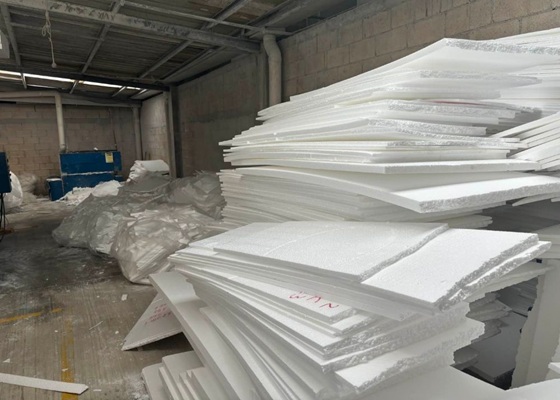
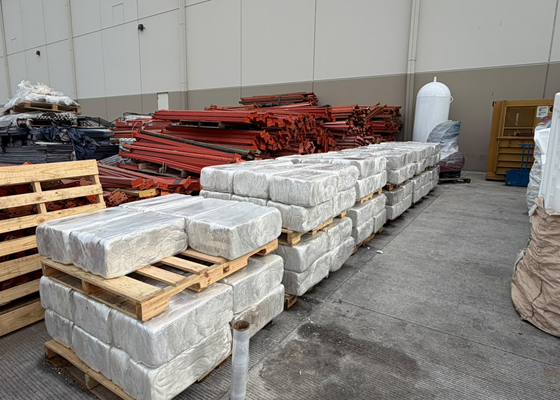
GREENMAX recently visited an Australian building products manufacturer that produces outdoor wall panels, flooring and sandwich panels. The company serves more than 200 customers and imports nearly 200 containers of products from China each year. Unpacking these products generates large quantities of EPS packaging, while sandwich panel production leaves cutting offcuts with a density of approximately 12–14 kg/m³.
During peak periods, loose foam can occupy almost half of the factory. Each outsourced collection costs approximately A$200. The disposal channels available to the customer do not accept EPS for landfill, while suitable EPS recycling services are not available nearby. As a result, the material quickly becomes a storage and operational burden.
Some of the company’s downstream customers face the same problem with accumulated EPS packaging. The manufacturer therefore plans to include foam collection and recycling support within its existing services. This would reduce waste pressure across its customer network while strengthening its ESG offering. With this objective in mind, the company contacted GREENMAX to assess a stable, long-term construction EPS recycling solution.
Choosing Between Two EPS Hot-Melt Machines
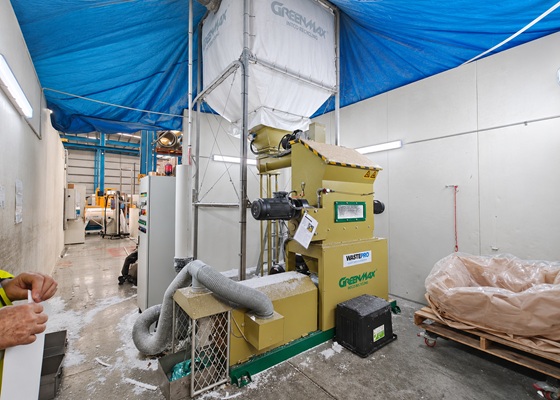
The customer plans to process the material once or twice a week using employees whose current workload is below full capacity. Based on this operating schedule, GREENMAX recommended two MARS series models: the M-C50 and M-C100 EPS melting machine.
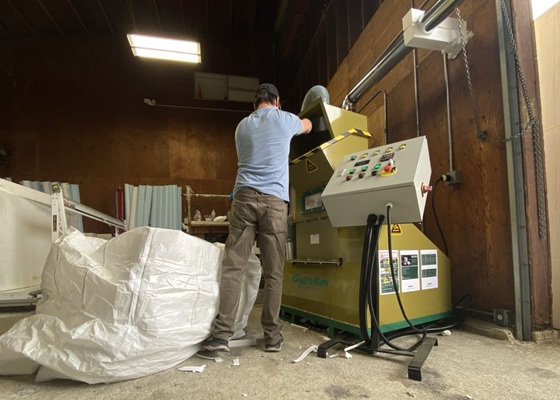
Both machines shred, heat and extrude EPS into dense melted blocks, achieving a volume reduction ratio of up to 90:1. Routine operation mainly involves start-stop controls and temperature settings, so employees can use the equipment after basic training.
The M-C50 has a smaller footprint, is easier to move and requires a lower initial investment. It takes approximately 20 hours to process one tonne of EPS, although larger foam pieces need to be broken down manually before feeding.
The M-C100 processes approximately one tonne in 10 hours. Larger pieces can be fed directly into the machine, reducing manual preparation and providing a higher level of automation.
Equipment, Servicing and Buy-back Questions
During the site discussion, the customer focused on equipment configuration, environmental requirements, local servicing and the sale of melted EPS blocks. GREENMAX addressed each point according to the proposed application.
· Equipment configuration: The machines can be configured with internationally recognised electrical components according to the site’s power and safety requirements. A basic exhaust system is included to support compliance with applicable Australian environmental and workplace requirements.
· Local servicing: GREENMAX works with an Australian service partner that can provide on-site maintenance. With correct operation and scheduled servicing, the equipment can remain in service for more than ten years.
· Material buy-back: Clean, non-flame-retardant Grade A EPS melted blocks have an indicative purchase price of approximately US$500 per tonne. The actual price depends on material quality and prevailing market conditions. During market fluctuations, compliant material produced by GREENMAX EPS melting machine users can receive priority consideration.
· Container collection: Once the customer has accumulated approximately 40 pallets, or around 20 tonnes, GREENMAX can coordinate a 40-foot high-cube container for collection from the factory. This reduces the need for the customer to organise the transport stage independently.
Check Available Funding Before Purchasing
Some Australian states have previously offered competitive funding programs for equipment used to process EPS and other hard-to-recycle plastics. Application periods, eligibility rules and co-contribution requirements vary between programs, so businesses should confirm current opportunities before purchasing equipment.
GREENMAX can also introduce an independent consultant to assist with preparing application documents. Funding approval and the final contribution rate remain subject to assessment by the relevant government body.
If your business regularly generates EPS packaging, insulation board or sandwich panel offcuts, provide GREENMAX with photographs of the material, its density and the estimated weekly volume. This information can be used to assess a suitable polystyrene recycling solution.
To discuss equipment selection and processing capacity based on your own material, contact GREENMAX via WhatsApp: +1 773 482 3129.
NEWS
- Industry News
- Company Dynamic
- Our Exhibitions
-
NSW Foam Recycling
- Polystyrene Melting Machine in NSW: Melt Foam Into Dense Ingots On-Site
- Retail Polystyrene Recycling in NSW: Turn Bulky Foam Into Dense Blocks On-Site
- Warehouse Polystyrene Recycling in NSW: Melt Bulky Foam Into Dense Ingots On-Site
- On-site Construction EPS Recycling: How an Australian Building Products Manufacturer Handles Polystyrene Packaging