
 Select Languange
 English
 Spanish
 Polish
 Japanese
 Italian
 French
Tacoma Case Study: How a Recycling Centre Tackled Bulky EPS Foam
Foam is one of those materials that looks harmless—until it starts piling up. At a recycling centre in Tacoma, Washington, incoming EPS (expanded polystyrene) kept increasing, and the “air” inside the material was taking up more space than the site could afford.
They needed a practical way to densify EPS on-site, keep operations moving, and reduce landfill reliance when collections couldn’t keep up.
The challenge: “We’re getting more foam than the system can handle”
Like many transfer stations and sorting facilities, the centre was dealing with real-world issues, not perfect lab conditions:
High inbound volume: around 40 cubic yards every two days at times
Unreliable downstream collection: local recyclers couldn’t always pick up promptly
Old equipment falling behind: existing machines had been used for years and couldn’t match the pace
Mixed foam stream: not just EPS—there was also EPE foam turning up in the same inbound flow
Landfill risk: when capacity and logistics fail, foam becomes “overflow”
The solution: GREENMAX M-C200E foam densifier
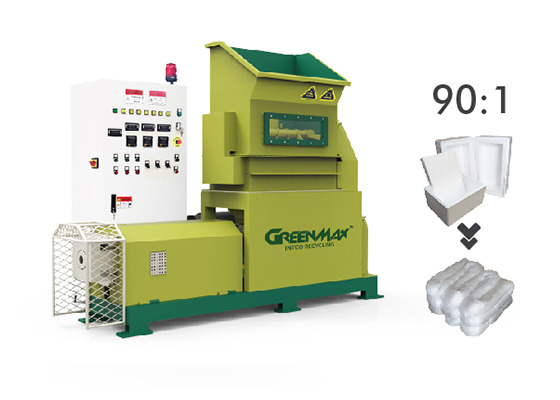
After an on-site review of needs, the recommended setup was a GREENMAX M-C200E foam densifier.
Why that model fit this site:
Capacity suited to a busy recycling centre (the M-C series is designed around continuous densifying workflows)
Works with mixed foam types, including EPS and EPE, which matters when inbound loads aren’t perfectly sorted
Operator friendly ramp-up: the operating principle was similar to their previous machine, making training easier
Compliance focus: the machine was delivered with UL certification completed for the overall unit
What changed on the floor: space, handling, and a “real product” at the end
Foam densifying isn’t just about making bales smaller. The point is to turn a storage problem into a manageable output.
With hot-melt densifying, EPS can be processed into dense ingots/logs and achieve a volume reduction up to ~90:1, which makes storage and transport far more practical.
Just as importantly, densified output is easier to move into downstream recycling markets (instead of being stuck as loose, bulky foam).
A detail that says a lot: pride of ownership
When the equipment arrived, the site supervisor was genuinely impressed by the build and presentation—enough to call it “her baby.” They even decorated the enclosure where the machine sat, turning a functional corner of the yard into something staff actually cared about.
It’s a small story, but it reflects something operational teams value: equipment that feels dependable, not “temporary.”
What Australian recycling operations can take from this case
If you’re running a council site, MRF, retailer back-of-house, or a regional consolidation point in Australia, the Tacoma scenario will feel familiar:
Foam volumes fluctuate and spike.
Collections don’t always align with your yard capacity.
“Good enough” legacy machines eventually become bottlenecks.
Mixed inbound streams (EPS + other foams) are the norm.
On-site densifying is often the difference between managing foam as a material and managing foam as a constant disruption.
.jpg "Tacoma (Washington)")
FAQ
What’s the difference between a foam densifier and a compactor?
A densifier (hot-melt) reduces volume far more aggressively by melting and forming dense output (ingots/logs). Compactors (cold press) compress without melting—useful, but typically lower reduction than hot-melt densifying.
What foam types did the Tacoma site handle?
They were receiving EPS and also EPE because inbound household/commercial waste can be mixed.
How much volume reduction can hot-melt densifying achieve?
Up to around 90:1 depending on material and workflow.
Why does certification matter?
Many facilities need equipment that aligns with site safety and compliance requirements; in this case, UL certification was completed for the unit.