
 Select Languange
 English
 Spanish
 Polish
 Japanese
 Italian
 French
How EPS Cold Press Compactor Improves Recycling Logistics for High-Volume Foam Waste
Project Snapshot
|
Field |
Details |
|
Case location |
Shanghai, China (urban recyclable transfer system) |
|
Customer |
Shanghai Blue Whale Resources Recycling Technology Co., Ltd. |
|
Equipment |
GREENMAX A-C100 in 2019; GREENMAX H-C300 hydraulic compactor in 2022 |
|
Material |
|
|
Daily throughput |
Approx. 700-800 kg/day |
|
Output density |
Approx. 300 kg/m3 |
|
Capacity |
Approx. 200 kg/h |
|
Staffing model |
1 operator for tape removal and machine operation; 1 maintenance staff |
Why this case matters for Australian recyclers
Australia's recycling geography makes low-density material especially expensive to handle. A foam load can fill a truck quickly while contributing little payload weight, so every kilometre travelled becomes more expensive per tonne. For EPS foam generated by appliances, furniture, cold chain logistics and packaging operations, volume reduction is often the difference between a workable recycling service and a high-cost collection problem.
This case shows how a city recycling operator used GREENMAX cold press technology to move from basic EPS volume reduction to a higher-capacity hydraulic compaction workflow. Although the project was implemented in Shanghai, the operating logic is highly relevant to Australian transfer stations, metropolitan recycling facilities and regional waste contractors that need to move bulky foam across long distances.
The challenge: loose EPS created storage and transport pressure
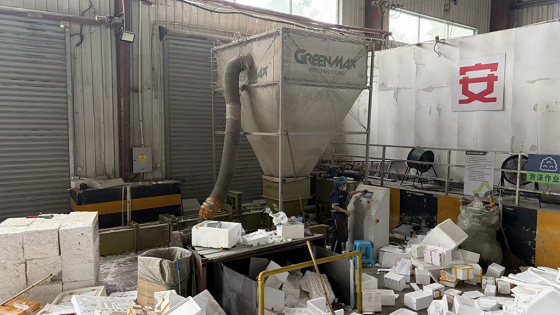
Shanghai Blue Whale Resources participates in local recyclable collection, transfer and waste sorting support services. EPS foam from home appliances, furniture, logistics and packaging channels created the same problem seen in many waste networks: it occupied large areas, increased vehicle movements and added labour to the transfer process.
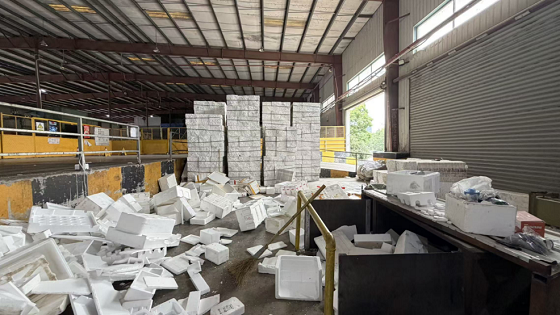
For a recycling company responsible for daily urban material flow, loose foam cannot simply wait for the next truck. It blocks working space, affects site management and reduces loading efficiency. The customer therefore needed a reliable way to turn scattered, bulky EPS into regular compressed blocks suitable for stacking, loading and further recycling.
From A-C100 to H-C300: an upgrade path as volume increased
Blue Whale Resources first purchased a GREENMAX A-C100 foam compactor in 2019. The machine helped reduce foam storage pressure and improve transport efficiency in the customer's daily recycling system. As business volume increased, the customer required higher processing capacity and stronger compression performance.
In 2022, the company selected GREENMAX again and added the H-C300 foam hydraulic compactor. This second investment is important from a business perspective: it shows that EPS recycling equipment should not be selected only for today's volume, but should also support future growth in collection and transfer demand.
The solution: H-C300 hydraulic cold press compaction
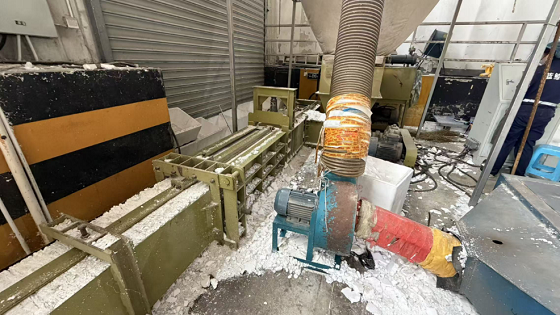
The GREENMAX H-C300 is mainly used for cold pressing EPS foam. Based on the site's operation, the customer processes approximately 700-800 kg of EPS per day. The H-C300 reaches a compacted density of around 300 kg/m3 and a capacity of about 200 kg/h, turning loose EPS into regular dense blocks.
For Australian operators, the value is direct: high-density blocks are easier to stage, bale-like in handling behaviour and far more economical to move than loose foam. This helps improve transfer efficiency before material enters downstream recycling channels.
Operational benefits for logistics-focused facilities
Lower storage pressure at collection and transfer sites.
Better truck payload efficiency compared with loose EPS foam.
Cleaner staging areas and simpler site management.
A practical staffing model: one operator plus one maintenance person in this case.
A scalable upgrade path from smaller compactor to hydraulic compactor as volume grows.
After-sales reliability: why service matters in daily recycling operations
The case also highlights the importance of after-sales support. When abnormal limit signals occurred, the GREENMAX service team checked the PLC input point, adjusted external wiring, optimized the internal program and recalibrated mechanical limit positions. After service, the H-C300 resumed normal operation.
For Australian recyclers working across multiple facilities, serviceability matters. A compactor that can be inspected, adjusted and returned to operation quickly helps protect daily throughput and avoids waste accumulation on site.
AU market takeaway
For Australia, EPS foam recycling should be planned around transport economics, not only machine capacity. A cold press compactor like GREENMAX H-C300 helps recyclers convert low-density foam into a transport-ready material, reducing fleet dependency and improving cost control across long-distance recycling routes.
This is especially useful for waste contractors, third-party recyclers, appliance take-back operators, packaging recovery facilities and council-linked transfer networks that need to manage bulky EPS consistently.
FAQ
What is an EPS hydraulic compactor used for?
An EPS hydraulic compactor cold-presses loose EPS foam into dense blocks, reducing volume and making storage, loading and transport more efficient.
Why is EPS foam recycling difficult in Australia?
EPS is extremely bulky and lightweight, so it fills vehicles before reaching useful payload weight. Long transport distances make this problem more expensive.
What density did the H-C300 achieve in this case?
The H-C300 achieved a compacted density of around 300 kg/m3 in this project.
How much EPS did the customer process per day?
The customer processed approximately 700-800 kg of EPS foam per day.
Why did the customer upgrade from A-C100 to H-C300?
The A-C100 helped reduce foam volume initially, but growing business volume created a need for higher capacity and stronger compression performance.