 Select Languange
 English
 Spanish
 Polish
 Japanese
 Italian
 French
How Blue Mountains City Council Upgraded Polystyrene Recycling with a GREENMAX M-C100
Blue Mountains City Council in New South Wales has upgraded its community polystyrene recycling programme with a GREENMAX M-C100 polystyrene melting machine. The project replaced a small rented unit that had become a processing bottleneck as participation from local households and businesses increased.
By installing a higher-capacity machine at its Community Recycling Centre, the council created a more efficient route from local EPS drop-off to on-site volume reduction and downstream material recovery.
Project overview
Customer: Blue Mountains City Council
Location: New South Wales, Australia
Application: Municipal and community polystyrene recycling
Material: Expanded polystyrene packaging, commonly known as EPS
Equipment: GREENMAX M-C100 polystyrene melting machine
Previous system: Small locally rented machine
Previous annual volume: Approximately 7–8 tonnes of EPS
Why polystyrene recycling was important to the council
Expanded polystyrene is widely used to protect appliances, electronics, furniture and other products during storage and transport. Its lightweight structure provides strong cushioning performance, but the same structure makes discarded EPS difficult to manage.
Loose polystyrene packaging occupies a large amount of space while contributing very little weight. Without volume reduction, it can quickly fill storage cages, skips and collection vehicles. This makes frequent transport necessary and can undermine the economics of polystyrene recycling.
For Blue Mountains City Council, the material was mainly delivered by residents and local businesses to the council’s Community Recycling Centre. The council therefore needed a solution that could operate reliably in a public drop-off environment and process increasing volumes without creating a backlog.
The limitation of the original rental machine
Before contacting GREENMAX, the council rented a small machine from a local Australian provider. This system allowed the council to establish an early polystyrene recycling programme and process around 7–8 tonnes of EPS per year.
However, participation gradually increased. More households and businesses began bringing packaging foam to the recycling centre, and the output of the small machine became a limitation.
The council faced several operational issues:
Incoming EPS could exceed the available processing capacity;
Loose foam required more temporary storage space;
Staff needed more time to manage accumulated material;
The rented machine offered limited capacity for future growth;
The council depended on equipment that it did not own.
The next stage of the programme required a larger and more stable polystyrene melting machine.
How GREENMAX developed the equipment recommendation
Blue Mountains City Council contacted GREENMAX in March 2025. Over the following two months, the two teams reviewed the council’s actual operating conditions.
The evaluation included:
Annual and projected EPS volumes;
The mix of residential and commercial drop-off material;
Available installation space;
Operating and staffing requirements;
Required processing capacity;
Long-term cost and recycling expectations.
After comparing the available equipment parameters, the council selected the GREENMAX M-C100.
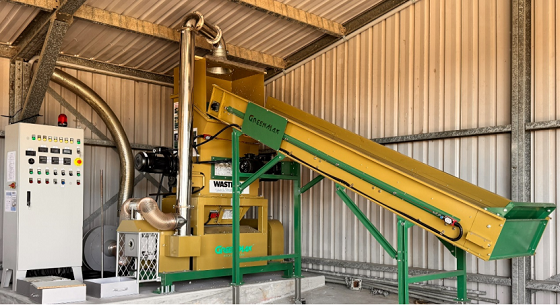
The solution: GREENMAX M-C100 polystyrene melting machine
The M-C100 is designed to reduce the volume of loose EPS through controlled crushing, heating and densification. The processed material exits the machine as dense polystyrene ingots that are easier to stack, store, load and transport.
For a municipal recycling centre, the process creates several practical advantages.
Faster on-site EPS processing
Instead of allowing loose foam to accumulate, staff can feed the collected EPS into the machine as part of the centre’s normal operating workflow.
Lower storage pressure
Dense ingots occupy substantially less space than untreated packaging foam. This helps the recycling centre make better use of its working and storage areas.
More efficient transport
The council no longer needs to transport large volumes of air-filled EPS. Densified material provides a much more effective payload per collection.
Greater programme stability
Owning a higher-capacity machine gives the council more control over its processing schedule and reduces dependence on a small rental system.
Customer feedback after installation
After the M-C100 was installed, Kevin Stewart, Coordinator of Katoomba Waste Management Facility, described the machine as performing very well and identified only one or two minor modifications that could make it even better.
The feedback reflects the council’s positive assessment of the machine’s processing capacity, operating stability and ease of use. More importantly, the M-C100 resolved the low-output bottleneck that had restricted the previous programme.
From community drop-off to recycled products
The value of the project extends beyond reducing foam volume.
Residents and businesses first bring clean EPS packaging to the Community Recycling Centre. The GREENMAX M-C100 then converts the loose material into dense ingots. These ingots can enter a downstream recycling route and be processed into recycled polystyrene raw material.
Recycled polystyrene can be used in remanufacturing applications such as decorative picture-frame mouldings. This gives the council a clearer circular pathway:
local collection → on-site melting and densification → material recovery → recycled manufacturing
Instead of being treated as bulky municipal waste, used EPS becomes a secondary raw material.
Why the case matters for Australian councils
Australia is reforming its packaging framework to improve packaging recovery, reuse, recycling and safe reprocessing while supporting circular-economy industries.
For councils operating community recycling centres, collecting EPS is only the first step. A programme also needs sufficient processing capacity and a viable downstream outlet.
The Blue Mountains project demonstrates three important lessons:
1. A small rental machine may be useful during the pilot stage, but capacity can become a constraint as participation grows.
2. On-site densification is critical because loose EPS is uneconomical to store and transport.
3. A successful polystyrene recycling programme needs both equipment and a downstream material recovery route.
FAQ
What is a polystyrene melting machine?
A polystyrene melting machine crushes and heats expanded polystyrene, reducing it into dense ingots that are easier to store, transport and recycle.
Where did the council’s EPS waste come from?
The material was mainly dropped off by local residents and businesses at the council’s Community Recycling Centre.
Why did Blue Mountains City Council replace its rented machine?
The smaller rental unit had become a processing bottleneck as community participation and EPS volumes increased.
What happens to the densified polystyrene?
The material can be processed into recycled polystyrene raw material and used in products such as decorative picture-frame mouldings.
Talk to GREENMAX about municipal polystyrene recycling
Councils and recycling centres need more than a collection cage for EPS. They need enough processing capacity to control storage, transport and downstream recovery.