 Select Languange
 English
 Spanish
 Polish
 Japanese
 Italian
 French
Why East Coast Appliance Selected a GREENMAX Polystyrene Melting Machine for Warehouse EPS Waste
A growing appliance retailer was filling roughly two 40-yard containers with EPS packaging every week, while a ten-year-old melting unit could no longer provide reliable output. The replacement project focused on throughput, safer indoor operation, reduced manual cutting and a viable downstream recycling route.
Project snapsho
|
Customer |
East Coast Appliance |
|
Case location |
Eastern United States |
|
Industry |
Appliance retail, warehousing and delivery |
|
Material |
Rigid EPS appliance packaging |
|
Waste volume |
Approximately two 40-yard containers per week |
|
Selected equipment |
|
|
Project status |
Equipment selected and purchased; delivery pending in the source case |
Project-stage note: The source case was documented after equipment selection and purchase but before installation. Benefits described below are the project objectives and expected operating improvements, not post-installation performance claims.
A packaging waste problem created by appliance growth
East Coast Appliance sells refrigerators, washing machines, televisions, dryers, dishwashers, cooking ranges and other household appliances. Its services also include delivery, installation, old-appliance removal and repairs. The business operates two warehouses and is planning a third location.
This operating model generates a continuous stream of rigid EPS packaging. Large appliances need thick protective mouldings, corner pieces and base sections. After unpacking, these components occupy warehouse space almost immediately.
The company reported enough EPS to fill approximately two 40-yard containers every week. Because expanded polystyrene is mostly air, the containers reached their volume limit long before they carried an efficient material weight.
Why landfill collections were no longer a practical long-term approach
Sending loose EPS directly to landfill required frequent container exchanges and ongoing transport and disposal spending. The growing foam volume also affected warehouse organisation, loading areas and staff movement.
• Bulky packaging consumed space that could otherwise support inventory and dispatch operations.
• Frequent container collections increased logistics and disposal exposure.
• Loose foam required repeated handling by warehouse staff.
• Expansion to a third warehouse would likely increase the same problem unless the process changed.
The business therefore needed polystyrene recycling to become part of warehouse operations rather than an occasional waste-removal activity.
The legacy machine had become a second bottleneck
East Coast Appliance already understood the value of volume reduction because it had operated a foam melting machine for more than ten years. However, frequent failures and unstable performance eventually made the equipment impractical to use.
Limited output and high labour input
The old system could process only about 50 to 100 pounds of EPS per day and required almost continuous attention from one employee. Its crusher was not strong enough for large, rigid appliance packaging, so workers had to cut pieces down manually before feeding.
Fumes and odour inside the warehouse
The unit also lacked an effective exhaust system. During melting, noticeable fumes and odours entered the indoor working area, creating concerns about the suitability of the process for normal warehouse operation.
The replacement specification therefore needed to solve reliability, crushing, heating, labour and exhaust issues together.
How GREENMAX specified the M-C100 project
GREENMAX reviewed the customer’s EPS shape, hardness, weekly container volume, warehouse conditions and downstream recycling expectations. The discussion also covered pricing, financing, delivery timing, technical support and recycled-material purchasing.
The customer compared multiple suppliers and contacted appliance businesses already operating GREENMAX equipment. These references helped the decision-making team assess how the machinery performed in real appliance warehouses and distribution environments.
Custom features selected for rigid appliance packaging
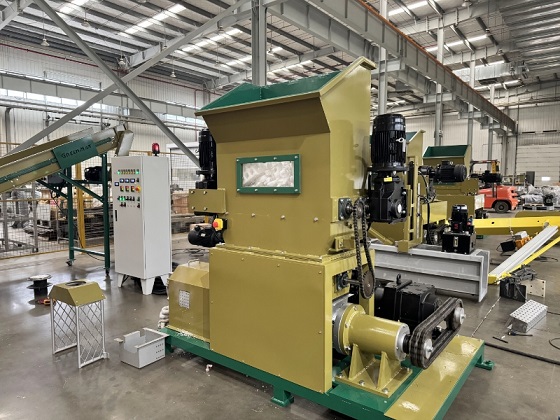
Double-crushing system
The M-C100 was specified with double crushing to accept larger and harder EPS packaging pieces. The objective is to reduce the amount of manual cutting required before feeding and improve the continuity of the warehouse workflow.
Increased heating capacity
Additional heating capacity was selected to support stable melting and consistent ingot formation when processing dense appliance packaging components.
Exhaust configuration for indoor use
An exhaust system was included to improve the management of fumes and odours during indoor operation. Final workplace ventilation and compliance arrangements still need to reflect the customer’s building, local requirements and installation design.
The business case included financing and material recovery
East Coast Appliance did not evaluate the project as a machine purchase alone. A financing solution was used to reduce initial capital pressure, while GREENMAX also discussed purchasing the densified EPS after production begins.
This creates a planned route in which the warehouse processes loose packaging into dense EPS ingots, the material is returned to the recycling system, and recycled polystyrene is used in new plastic products.
|
Appliance delivery → EPS unpacking waste → on-site crushing and melting → dense EPS ingots → material purchase and reprocessing → recycled plastic products |
Expected operational improvements after commissioning
Once installed and commissioned, the M-C100 is expected to help the business recover warehouse space, reduce container collections and lower the labour required for cutting and handling foam.
• Process large, rigid EPS pieces with less manual size reduction.
• Replace unstable legacy equipment with a purpose-specified system.
• Reduce the volume of packaging held in warehouse staging areas.
• Improve the effective payload of material sent for recycling.
• Create a defined outlet for densified EPS rather than relying only on disposal.
Why the case is relevant to Australian appliance retailers
Australian appliance retailers and distribution centres face the same basic mismatch: products are heavy and valuable, while the protective EPS left after delivery is lightweight but extremely bulky. Long transport distances can make loose-foam collections especially inefficient.
Australia is continuing to reform packaging regulation so packaging is designed around recovery, reuse, recycling and safe reprocessing. A warehouse polystyrene recycling programme can support that direction when it combines suitable equipment, clean material separation and a confirmed downstream outlet.
For an Australian site, the equipment decision should consider weekly EPS volume, the physical size of appliance mouldings, electrical and ventilation requirements, labour availability, service access and the destination for densified material.
FAQ
Why do appliance warehouses generate so much EPS waste?
Refrigerators, televisions, washing machines and other large appliances use rigid expanded polystyrene mouldings for impact protection. Once products are unpacked, the packaging remains bulky even though it weighs very little.
What was wrong with the customer’s previous foam melting machine?
The unit was more than ten years old, broke down frequently, processed only around 50 to 100 pounds per day, required extensive manual cutting and lacked an effective exhaust system.
Why was double crushing selected for the GREENMAX M-C100?
Large appliance packaging can be rigid and difficult to feed. Double crushing is intended to accept larger pieces and reduce the labour required to cut foam before processing.
Has the new M-C100 already delivered measured savings?
Not in the source case. The machine had been selected and purchased, with delivery expected within several weeks. Space, transport and labour reductions were project objectives rather than verified post-installation results.
What happens to the EPS after melting and densification?
The planned process converts loose foam into dense EPS ingots. These can be purchased and returned to a recycling system for processing into recycled polystyrene raw material and new plastic products.
Plan a polystyrene recycling system for your appliance warehouse
Share your weekly EPS volume, container collection frequency, packaging photos, warehouse layout and current disposal method with GREENMAX. The team can assess whether a polystyrene melting machine, a different densification technology or a staged collection model is more suitable.