 Select Languange
 English
 Spanish
 Polish
 Japanese
 Italian
 French
GREENMAX EPS Recycling System for Reusing Production Waste
Cutting, trimming and moulding EPS products generates a steady stream of offcuts, loose particles and fine dust. This in-house waste is usually clean enough to recover, but inconsistent particle sizes and excessive dust can affect foaming and moulding if the material is fed straight back into production.
The GREENMAX EPS recycling system is designed for EPS board manufacturers, moulded packaging producers and cutting facilities. It combines crushing, screening, dust removal, storage and blending in one line. Reusable material is separated from oversize particles and fines, then mixed with virgin EPS beads at a controlled ratio for use in new products.
In the 2026–27 financial year, the waste levy in the NSW Metropolitan Levy Area is A$180.20 per tonne. Recovering production waste on site can reduce virgin material consumption as well as the volume sent to landfill. It also supports Australia’s broader shift towards resource recovery and increased recycled-content use.
How Does the EPS Recycling System Process Production Waste?
1. Crushing EPS Offcuts
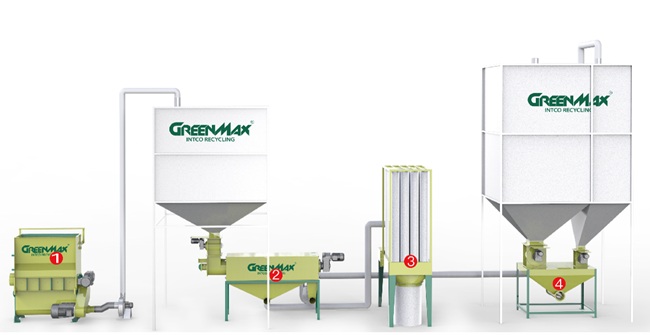
EPS waste first enters the crusher, marked as No. 1, where it is reduced to smaller particles. The crusher has a capacity of 25–30 m³/h and uses an 8 mm screen to produce a more consistent feed for the next stage.
2. Separating Reusable Material
The crushed material is transferred by pipe to the de-duster, marked as No. 2. A 2 mm screen separates usable regrind from excessively fine particles. Removing these fines helps produce more consistent recycled EPS beads for blending and reduces the amount of dust entering the moulding process.
3. Collecting EPS Dust
Separated EPS dust is directed into the independent dust collector, marked as No. 3. This enclosed collection stage limits loose particles around the equipment and helps keep the production area cleaner.
The collected dust still has recycling value, even though it may not be suitable for direct reuse in the current moulding process. EPS fines can be thermally densified using a GREENMAX polystyrene compactor. The resulting ingots can then be sold to GREENMAX and processed into recycled products such as frames, decorative mouldings and flooring.
4. Blending with Virgin EPS Beads
Qualified regrind enters the mixer and silo system, marked as No. 4. The final silo has separate storage sections for recovered material and virgin EPS beads, allowing the two materials to be blended at a controlled ratio.
A recycled-material ratio of 6%–20% is commonly recommended as a starting range. The actual mix should be determined through production trials, taking into account the EPS grade, particle size, product density, surface requirements and moulding conditions.

Australian Case Study: Koolfoam Reuses EPS Production Waste
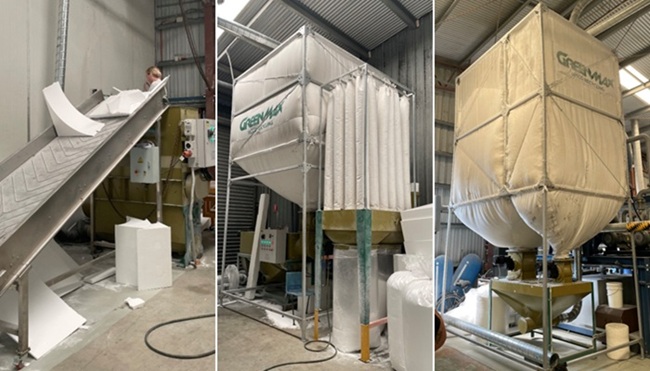
Koolfoam is an Australian foam manufacturer with more than 40 years of experience producing custom packaging, pipe insulation and thermal insulation products. To manage EPS offcuts generated during production, GREENMAX supplied an EPS recycling system that connects with the company’s existing production line and integrates crushing, dust removal, screening and blending.
The system began operating in 2022. After screening, suitable regrind is blended with virgin material and returned to production. Koolfoam has tested two mixtures containing 10% and 40% regrind. Both have performed well, and the company continues to refine the ratios for different production requirements.
Reducing Raw Material and Waste Disposal Costs
On-site recovery turns clean EPS production waste into usable regrind, while reducing storage, transport and disposal. By controlling particle size and removing dust, this closed-loop polystyrene recycling system also improves blending consistency.
1. Reduce Virgin EPS Bead Use
Regrind can typically replace up to 20% of virgin EPS beads. The appropriate ratio depends on material quality, product density and moulding requirements.
2. Lower Waste Disposal Costs
In 2026–27, general waste levies are A$135 per tonne in metropolitan Queensland and A$180.20 per tonne in metropolitan NSW, excluding transport and gate fees. On-site recovery reduces the waste exposed to these costs.
3. Manage Raw Material Price Changes
In-house regrind reduces reliance on imported virgin beads, providing a practical buffer against price rises and supply delays. This approach also supports Australia’s resource-recovery goals, including APCO’s packaging targets and the National Waste Policy Action Plan’s 80% average resource recovery target by 2030.
Technical Data
Equipment
Capacity
Power
Dimensions (mm)
Screen Size
Crusher
25–30 m³/h
15 kW
1750 × 780 × 2012
8 mm
De-duster
25–30 m³/h
4.87 kW
3498 × 703 × 1955
2 mm
Dust Collector
—
7.5 kW
2310 × 950 × 3390
—
Mixer
55–100 m³/h
3.92 kW
1598 × 990 × 1724
—
Frequently Asked Questions
1. Isn’t this simply an EPS grinder?
No. An EPS grinder only reduces the material in size, leaving reusable particles mixed with fine dust. This system adds screening, dust removal, storage and controlled blending, producing cleaner and more consistent regrind for reuse in moulding.
2. Will regrind affect product quality?
That depends on particle size, dust content, the mixing ratio and the finished product. Screening and dust removal improve the consistency of the regrind, but the final ratio should always be confirmed through production trials.
3. How much virgin material can be replaced?
A ratio of 6%–20% is a practical starting range for many applications. Products with demanding surface requirements may need a lower proportion. Higher ratios can be considered for EPS blocks or less appearance-critical products after testing; Koolfoam, for example, has trialled a mixture containing 40% regrind.
4. Is the system suitable for an EPS cutting business that does not mould products?
It can be, depending on waste volume and local outlets. After crushing, screening and dust removal, the recovered material can be sold as more consistent regrind. Fine material that cannot be reused directly may be sent to a GREENMAX compactor for densification, reducing the amount requiring storage, transport or landfill disposal.