 Select Languange
 English
 Spanish
 Polish
 Japanese
 Italian
 French
Warehouse Polystyrene Recycling in NSW: Melt Bulky Foam Into Dense Ingots On-Site
Warehouses don’t “generate waste” — they generate volume
If you run a warehouse, DC, or logistics terminal in NSW, you already know the pattern: unpacking and cross-dock operations create a steady stream of foam packaging—especially from white goods, furniture, electronics, and fragile freight.
The issue isn’t the weight of polystyrene (EPS). It’s how quickly it takes over:
Receiving bays and waste zones
Cages and skips that “fill up” long before they’re heavy
Housekeeping time (foam fragments spread easily)
Collection frequency (moving “air” again and again)
A practical solution is on-site melting: turning loose foam into dense ingots that stack neatly and move efficiently.
Why on-site melting fits warehouse workflows
A warehouse needs a process that’s repeatable, low-friction, and scalable.
With a polystyrene melting machine (EPS hot melter / densifier), you can:
Keep foam contained (less mess and overflow)
Free up floor space in your yard and waste area
Reduce pickup pressure by consolidating output
Standardise handling across shifts and sites
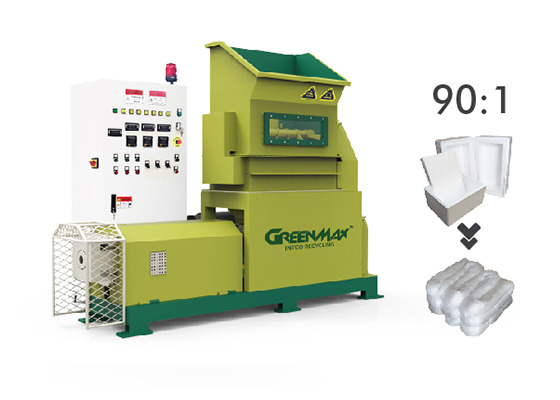
Recommended for warehouses: Polystyrene Melting Machine (Ingots)
This on-site system is designed for operational environments where foam arrives daily and storage space is at a premium.
Key operational fit
Output: dense ingots (stackable, easier to palletise and store)
Capacity range: 50–300 kg/h (choose based on inbound volume and operating hours)
No shredder required (simpler footprint and fewer steps)
Materials supported
EPS / EPE / XPS / PSP / EPP
Warehouse tip: when different suppliers send different foam types, being able to handle mixed streams reduces sorting effort and keeps the process moving.
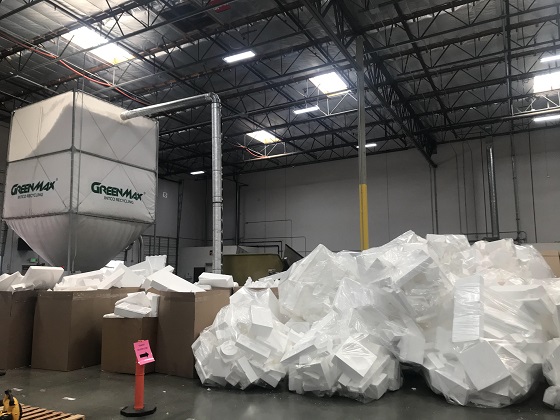
Proof from logistics: Mainfreight New Zealand
Mainfreight is a global logistics company, and your published content highlights its use of GREENMAX equipment to manage polystyrene packaging waste from operations handling appliances and furniture.
Your AU page describes Mainfreight New Zealand cooperating with GREENMAX to recycle polystyrene home appliance packaging waste.
Another published article states Mainfreight generates 70–100 cubic meters of waste EPS per week, and after using a GREENMAX EPS recycling machine, reported savings of NZ$50,000/year in disposal costs and nearly NZ$20,000/year in revenue.
A separate page also notes Mainfreight purchased an Apolo series A-C100 polystyrene compactor in 2020 and was satisfied with the result.
What this tells NSW warehouse operators:
When foam volume is continuous and high, on-site densification (melting into ingots or compacting into blocks) is a proven way to bring the stream under control—operationally and financially.
Warehouse SOP (copy/paste ready)
1) Set up your foam handling point
Place a foam-only collection cage/bay near unpacking
Keep foam dry
Avoid hard contaminants (metal/wood/rigid plastics)
2) Run a simple routine
Melt foam on a daily schedule (high volume) or 2–3× weekly (moderate volume)
Stack ingots in a dedicated storage zone
Consolidate loads for transport/collection
3) Keep it consistent across shifts
one output rule (ingots)
one storage location
one owner per shift
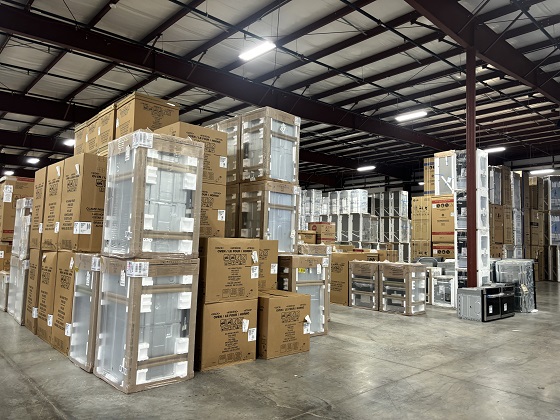
Servicing NSW warehouse & DC sites — statewide on-site support
We service warehouse, DC, and logistics sites across all cities in NSW through our exclusive local Australian agent, providing on-site support for installation coordination, commissioning guidance, and after-sales service.
Whether you operate in metro Sydney or regional NSW, we help you set up a repeatable process: collect foam → melt into ingots → stack/palletise → consolidate loads for transport.
Want to stop foam overflow in your receiving area?
FAQ
Q1. What’s the difference between a hot melter, densifier, and melting machine?
In warehouse settings, these terms are often used for the same goal: turning loose foam into a dense, transportable output (like ingots) on-site.
Q2. Do we need a shredder before melting?
No—your setup can be positioned as no shredder required, which simplifies footprint and labour steps.
Q3. What throughput is suitable for warehouses?
It depends on inbound packaging volume and operating hours. Your range covers 50–300 kg/h, which fits everything from single depots to high-volume DC workflows.
Q4. What materials can be processed?
EPS, EPE, XPS, PSP, and EPP—helpful for mixed packaging streams.
Q5. Is there proof this works in logistics?
Yes—your published content describes Mainfreight New Zealand using GREENMAX solutions for polystyrene packaging waste and reports meaningful cost savings and revenue outcomes.