
 Select Languange
 English
 Spanish
 Polish
 Japanese
 Italian
 French
How a GREENMAX Foam Densifier Improved EPP and EPS Foam Recycling for an Industrial Waste Operator
Project Snapshot
|
Case region |
Czech Republic, Europe |
|
Industry |
Industrial waste management |
|
Materials |
EPS packaging foam + EPP industrial packaging foam |
|
Equipment |
|
|
Monthly volume |
Approx. 20 tonnes of EPS and EPP foam waste |
|
Keywords |
EPP foam recycling, EPS foam recycling, foam densifier, GREENMAX |
The challenge: bulky industrial foam was limiting transport efficiency
For waste operators, industrial foam is rarely a simple collection-and-disposal issue. EPS and EPP foam are both lightweight and bulky, which means they occupy storage and transport capacity quickly before generating enough payload value.
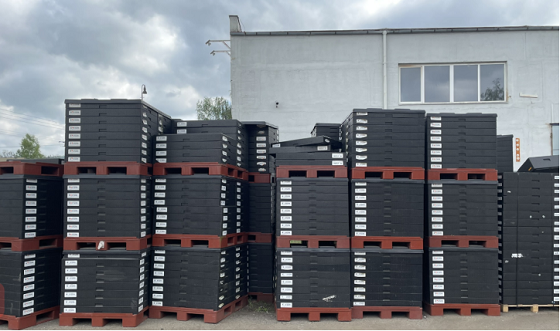
In this case, the recycling company needed to handle around 20 tonnes of industrial foam waste per month: approximately 10 tonnes of EPS packaging waste from the home appliance industry and 10 tonnes of EPP packaging waste from the automotive parts sector. The EPP material was loaded on European standard pallets, with a maximum size of 60 x 80 cm and a typical density of 40-70 kg/m3.
For Australian recyclers, this type of challenge is especially relevant. Long transport distances, regional service routes and warehouse space pressures can make low-density foam expensive to move unless it is densified close to the source.
Why EPP foam recycling needs stronger equipment than EPS
Compared with EPS, EPP foam is tougher, denser and more resilient. This gives EPP strong value in automotive parts packaging and reusable industrial packaging, but it also makes the recycling process more demanding.
A standard EPS-only workflow may struggle with harder crushing requirements, unstable feeding when material rebounds, uneven block formation and lower compaction consistency for rigid EPP materials.
Why GREENMAX recommended the Z-C200 foam densifier
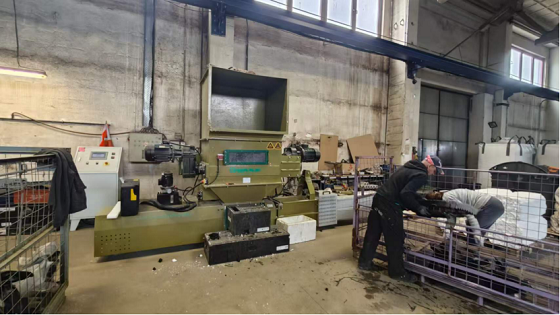
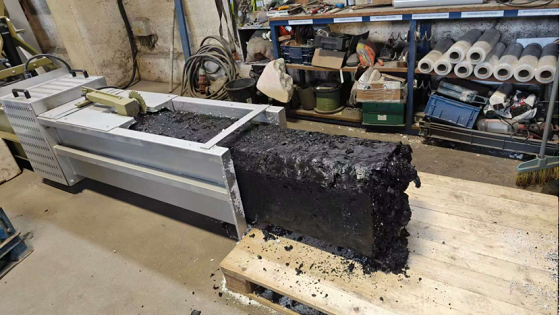
During equipment selection, the customer compared screw compaction equipment with foam densifier options. GREENMAX recommended the Z-C200 foam densifier because cold-compacted EPS and EPP blocks have better market circulation in Europe than hot-melted material, and they are easier for downstream companies to sort, transport and reprocess.
For Australian recyclers, this is an important business point: the value of foam recycling does not stop at volume reduction. The output format must also match downstream market expectations.
Customisation for EPS and EPP materials
Two reinforced 5.5 kW crushing motors for high-density EPP foam.
Variable frequency speed control on the main screw.
Adjustable processing parameters for different foam characteristics.
Stable feeding for lightweight EPS and stronger block compactness for EPP.
Results: stable monthly processing and better recycling value
After installation and remote commissioning, the recycling company was able to process around 20 tonnes of EPS and EPP foam waste per month. Bulky foam was crushed and compacted into uniform blocks, reducing storage pressure and improving transport efficiency.
For the customer, the key result was not only cleaner material handling, but a better business model: low-value loose foam could be transformed into sellable recycled resources.
Why this matters for Australian waste operators
· Improves payload efficiency across long-distance collection routes.
· Reduces on-site storage pressure for manufacturers and warehouses.
· Helps downstream buyers receive more consistent material blocks.
· Supports more scalable industrial foam recycling services.
FAQ
What is the difference between EPS and EPP foam recycling?
EPS is lighter and easier to compact, while EPP is denser, tougher and more resilient. EPP foam recycling usually requires stronger crushing and more stable compaction control.
Can one foam densifier process both EPS and EPP?
Yes. In this case, the GREENMAX Z-C200 was customised to handle both EPS and EPP foam waste with reinforced crushing and adjustable screw speed.
Why is cold compaction useful for industrial foam recycling?
Cold-compacted blocks can be easier for downstream recyclers to sort, transport and reprocess, especially where the recycled material market prefers non-melted foam blocks.
How much foam did the customer process per month?
The customer processed approximately 20 tonnes of EPS and EPP industrial foam waste per month after installation.