 Select Languange
 English
 Spanish
 Polish
 Japanese
 Italian
 French
Polyethylene foam compactor field test: Singapore logistics and packaging firm WM chooses GREENMAX
For WM, a Singapore logistics and packaging business, EPS foam and PE foam had been a persistent headache in day-to-day operations.
Both materials are light but bulky, and they quickly swallowed warehouse and holding space. Disposal was the bigger problem. Until the company had a suitable poly foam recycling machine on site, most of its foam waste went to landfill. WM carried the cost of collection, transport and disposal, while plastic with genuine value never reached a PE foam recycling stream. Australian businesses will recognise the picture: around 19 per cent of EPS packaging in Australia is recovered, kerbside bins do not accept foam, and recycling depends almost entirely on commercial and industrial sources handling it themselves. Whatever is not processed ends up buried.
Cutting that volume — and breaking the habit of landfill — was exactly what WM set out to solve.
From comparing brochures to a live trial at GREENMAX's factory in China
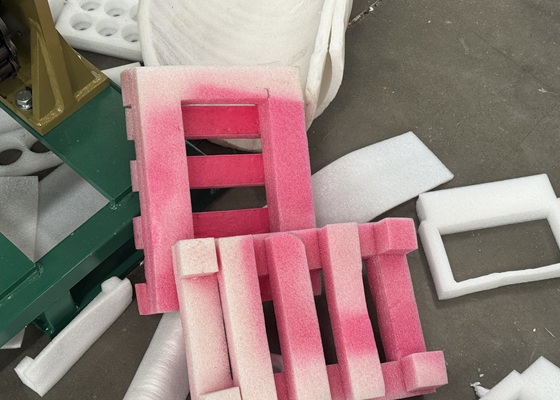
Before purchasing, WM's team compared several foam equipment suppliers. Rather than relying on brochure parameters, they wanted evidence of real output, machine stability and long-term running costs. So the team travelled to GREENMAX's manufacturing base in China, bringing their own PE foam for testing.
During the factory visit, the WM team saw how the machines are manufactured, assembled and tested — then ran a live trial with their actual material.
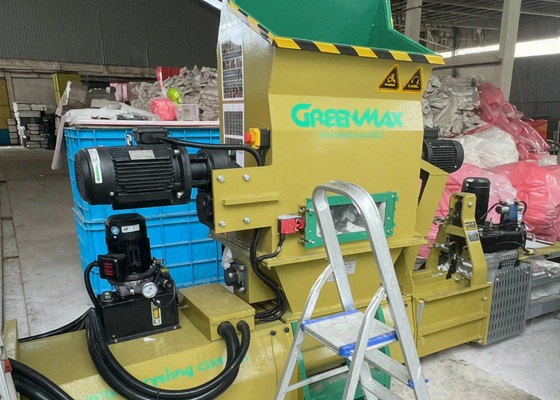
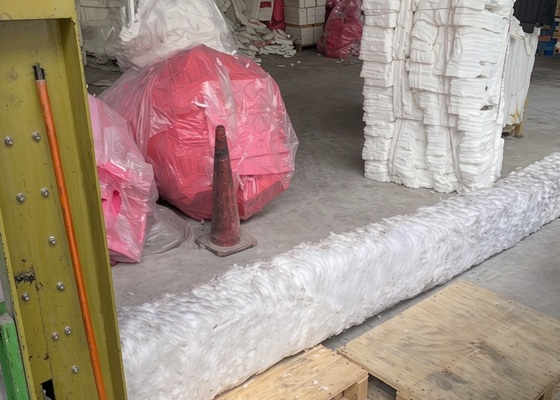
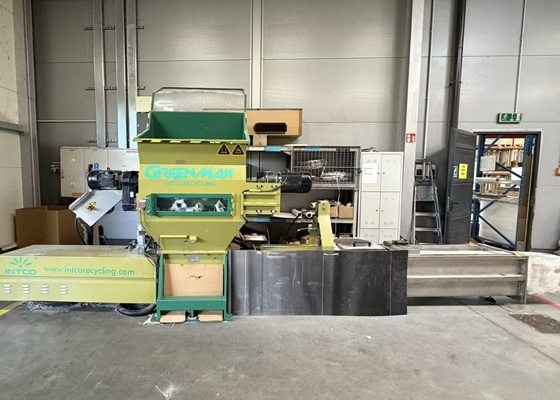
For PE foam, a tough, flexible material, GREENMAX recommended the ZEUS Z-C200 polyethylene foam compactor. Foam is shredded at the front of the machine, then fed through a screw-driven mechanical press that forces the air out, producing a dense block that is easy to stack and transport. In the on-site test, foam volume was cut by roughly 50 times. For WM, a trial using its own waste was worth more than any theoretical data sheet: feed behaviour, block quality and continuous performance could all be verified before a single dollar was committed.
Z-C200 first solved the 'shipping air' problem
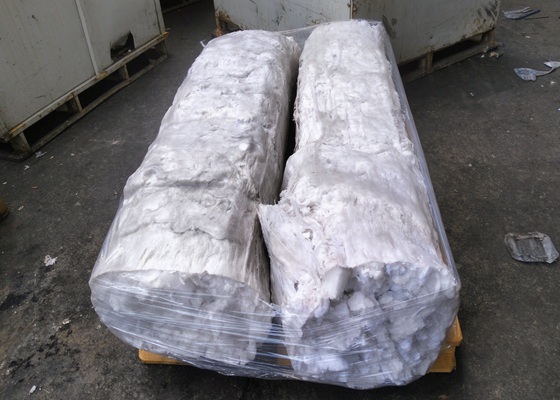
The biggest logistics problem with PE foam waste is its extremely low bulk density.
Untreated poly foam can fill an entire truck while carrying very little actual plastic. In effect, businesses pay to transport the air trapped inside the material.
Once the GREENMAX ZEUS Z-C200 poly foam recycling machine Australia was running, loose foam came out as regular, high-density blocks. The same weight of material needed far less storage and transport space, allowing WM to extend collection cycles and put more usable weight on every trip.
For a logistics and packaging company like WM, the value of a polyethylene foam compactor goes beyond making foam smaller. It changes the economics of storing and moving waste.
From landfill to PE foam recycling
More important than the savings in space and freight was where the waste ended up.
Without a machine, foam waste had no economical way of being densified, so most of it went to landfill. Loose foam was also inefficient to transport, which limited its chances of reaching professional recycling channels. Australia is a case in point: recovery channels are mostly commercial, a single drop-off of loose foam carries little material, and transport can easily cost more than the load is worth — so many businesses simply give up.
After densification in the Z-C200, the foam was significantly denser, far better suited to consolidated storage and long-distance transport, and ready for genuine recycling.
Through the recovery and reprocessing network built by GREENMAX's parent company, INTCO Recycling, densified foam can move into downstream processing and become recycled plastic feedstock for products such as decorative mouldings and picture frames. In Australia, compacted blocks are readily accepted by recovery networks such as EPSA, StyroCycle and GREENMAX — the material leaves the site and enters a real recycling chain rather than finishing in landfill.
Why the live trial decided the purchase
Foam waste differs from business to business — in density, size, toughness and site conditions — so the theoretical capacity of a polyethylene foam compactor can never fully replace testing with real material.
A major reason WM chose the GREENMAX Z-C200 was the chance to trial it with its own waste.
Customers see the actual compression ratio, whether the machine feeds smoothly, whether blocks hold their shape, and whether the output suits their production conditions.
As WM's manager commented after the trial, watching your own material being processed is a completely different experience from reading technical specifications.
After the factory visit and live test, WM formally ordered the GREENMAX ZEUS Z-C200. Since commissioning, the company's approach to foam waste has shifted from landfill toward densification and recycling.
The value of densification goes beyond 50x volume reduction
WM's case shows that for businesses generating low-density EPE and EPS waste, the real problem is not simply waste removal.
A well-matched poly foam recycling machine — the type Australia's logistics and packaging operators increasingly rely on — first cuts floor space and transport pressure. More importantly, it fixes the uneconomic logistics of low-density foam and creates the conditions for PE foam recycling.
For logistics centres, packaging businesses and manufacturers, testing equipment with your own material before purchase — and weighing the investment against current landfill fees, transport and storage costs — produces a far more accurate buying decision than comparing equipment prices alone.