
 Select Languange
 English
 Spanish
 Polish
 Japanese
 Italian
 French
Polystyrene Melting Machine in NSW: Melt Foam Into Dense Ingots On-Site
Loose foam takes up space fast. If your NSW site deals with EPS packaging, offcuts, or mixed foam streams, a polystyrene melting machine can turn bulky foam into dense ingots you can stack, store, and ship efficiently. Also known as an EPS hot melter or foam densifier, this system is designed for day-to-day operations—without needing a separate shredder.
Talk to us about a NSW on-site foam melting setup
What This Machine Does (and Why NSW Sites Use It)
A polystyrene melting machine reduces the biggest headache of foam waste: volume. By converting loose foam into compact ingots, you can:
1. Free up floor space in back-of-house or yard areas
2. Lower collection frequency by improving payload
3. Keep foam contained (less mess, less wind-blown loss)
4. Create a consistent output form for downstream handling
Best fit for: warehouses, retail back rooms, construction sites, distribution centres, packaging-heavy operations.
Materials You Can Process
This model is built for a wide mix of foam streams—useful for NSW sites that don’t want to manage multiple machines.
Supported materials
EPS (expanded polystyrene packaging & offcuts)
EPE
XPS
PSP
EPP
If you’re not sure what your foam is, share a photo or sample description and we’ll help identify the best setup.
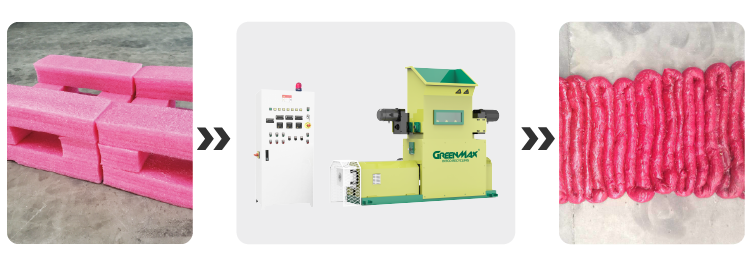
Output Form — Dense Ingots That Stack and Ship
Instead of bags of loose foam, you get ingots that are:
Easy to palletise and store
Stable for transport
Easier to count/track in a waste-management SOP
This is especially helpful when multiple departments generate foam and you want a simple “one output, one handling rule” process.
Capacity & Power (Key Specs for NSW Planning)
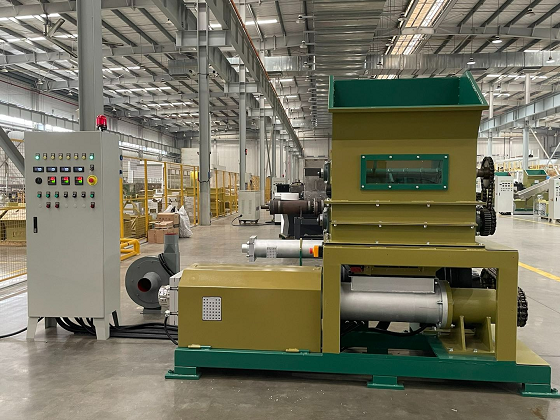
Throughput range: 50–300 kg/h (model dependent)
Power reference: 7.5 kW at 50 kg/h (other models vary)
Pre-shredding required: No — the system is designed to process foam without a separate shredder
Where It Fits Operationally (Simple On-Site Workflow)
A practical workflow many NSW sites follow:
1. Collect foam at source (receiving area / unpacking zone / site bins)
2. Keep it dry & free of hard contaminants (labels/tape are manageable; avoid mixed rigid plastics/wood/metal)
3. Feed into the melting system
4. Store ingots safely until scheduled collection/transport
If you operate multiple locations in NSW, you can standardise this as a repeatable SOP across stores or depots.
NSW Applications We See Most Often
Construction & Fitout (EPS offcuts)
Insulation & packaging offcuts accumulate quickly
Storage is messy and space-intensive
Ingots make site waste handling more predictable
Retail Back-of-House (packaging foam)
Constant inbound packaging
Limited backroom space
Need quick, repeatable handling
Warehouses & E-commerce
Stable, high-volume packaging streams
Process discipline is easier to enforce
Strong payoff from fewer collections
FAQ
What capacity should I choose: 50 kg/h or higher?
Use 50 kg/h when foam is consistent but moderate. Step up when you have high daily inbound packaging, multiple departments generating foam, or frequent collection pain. We can size a model from 50–300 kg/h based on your volume and staffing.
How clean does the foam need to be?
Keep foam dry and avoid hard contaminants (metal/wood/rigid plastics). Light packaging tape/labels are usually manageable, but cleaner inputs improve downstream handling.
Is it suitable for multiple NSW sites (multi-store / multi-warehouse)?
Yes. Many operators adopt a standard SOP: collect → feed → store ingots → schedule pickups, which is easy to replicate across locations.
How do I get full dimensions and model-specific specs?
Tell us your foam type mix and approximate volume, and we’ll recommend the right model and send the full parameter sheet (footprint, power, throughput, output details).
Servicing NSW businesses
We support NSW sites with equipment recommendations, delivery, installation guidance and after-sales support. Common service areas include Sydney, Newcastle, Wollongong and the Central Coast.