 Select Languange
 English
 Spanish
 Polish
 Japanese
 Italian
 French
How a Paris Recycler Improved EPS Recycling with a GREENMAX EPS Compactor
Project Snapshot
|
Country |
France |
|
Industry |
Recycling |
|
Material |
EPS |
|
Machine |
The challenge: too many pick-ups, not enough payload
A recycler in Paris had been providing EPS recycling services for local customers for years. These customers generated large amounts of foam packaging waste every day, and the recycler collected the material on a regular schedule.
At first, the model worked well. But as collection volumes grew, the business started facing a major problem: transport costs were rising too quickly. EPS is bulky and lightweight, so trucks looked full even when the actual payload was low. That meant more trips, more fuel, more labour, and more vehicle wear, without a matching increase in recycling value.
Why the old workflow was becoming unprofitable
After reviewing operations, the recycler identified the real bottleneck: loose EPS foam was taking up most of the truck space before the load had any meaningful weight. In practice, the company was transporting air as much as material.
That created a familiar commercial problem in EPS recycling. As the business grew, so did the number of trips and the logistics spend. Instead of scaling profitably, the recycler risked getting trapped in a model where growth only pushed costs higher.
Why GREENMAX
After learning about GREENMAX, the recycler contacted the team to evaluate a better way to handle EPS at source. Following discussions, they decided to place a GREENMAX EPS compactor directly at the customer’s site.
This changed the thinking behind the recycling process. Instead of collecting loose foam, the recycler would collect compacted, high-density EPS blocks. That made EPS recycling far more commercially viable.
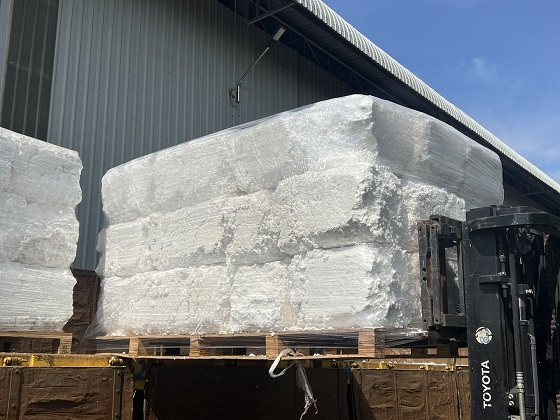
The solution: GREENMAX A-C200 EPS compactor
Once the A-C200 was installed, the workflow changed immediately. EPS waste no longer piled up waiting for collection. Instead, the foam was fed directly into the EPS compactor, where it was compressed into dense blocks.
Operational benefits after installation
• Less foam accumulation on site.
• Cleaner, more organised operating space.
• Lower-frequency, higher-efficiency transport.
• More usable payload per shipment.
Results: lower costs and stronger margins
• Compaction ratio reached 50:1.
• Transport frequency dropped sharply.
• Fuel, labour, and vehicle costs decreased.
• Profit margins improved.
• Lower operating costs helped strengthen the long-term customer relationship.
Why this matters for Australian recyclers
For recyclers and waste operators in Australia, transport efficiency is often the make-or-break factor in EPS recycling. Lightweight foam can consume truck space quickly while generating poor payload efficiency.
An EPS compactor helps solve that by reducing volume at source. For operators handling regular foam collections, this can turn EPS recycling from a high-effort, low-margin service into a more sustainable and scalable business model.
FAQ
What does an EPS compactor do?
An EPS compactor compresses loose foam into high-density blocks, reducing volume and making transport more efficient.
Why is EPS difficult to transport?
Because EPS is bulky and lightweight. Trucks can appear full while carrying relatively little usable material.
What compaction ratio was achieved in this case?
The GREENMAX A-C200 reached a compaction ratio of 50:1 in this project.
Why is on-site compaction important for EPS recycling?
It reduces storage pressure, improves collection efficiency, cuts logistics costs, and helps make EPS recycling more profitable.