 Select Languange
 English
 Spanish
 Polish
 Japanese
 Italian
 French
How to Recycle XPS Foam Boards in Australia
XPS foam boards can be recycled when they are collected separately and kept free from excessive construction contamination. For Australian insulation manufacturers, building-material suppliers, contractors and recyclers, the practical approach is to sort the XPS, reduce oversized boards when necessary, and compact or hot-melt the material into dense blocks or ingots for downstream recycling.
GREENMAX provides XPS recycling machines that help businesses reduce bulky foam waste, lower storage and freight requirements, and create a more manageable recycled polystyrene output. The correct solution depends on the source of the waste, its size and cleanliness, the volume generated, available site space and the preferred finished material.
What Is XPS Foam?
XPS stands for extruded polystyrene. It is a rigid, closed-cell foam commonly used for thermal insulation in roofs, walls, floors, cold stores and other building systems. Its lightweight structure provides effective insulation performance, but the same low density creates a waste-management problem: loose XPS boards occupy substantial space while containing relatively little material by weight.
Although XPS and EPS are both polystyrene foams, they are produced differently and have different structures. XPS is generally supplied as rigid insulation board, while EPS is more commonly seen as moulded packaging, fish boxes and bead-based insulation products. Separating the two materials can improve processing consistency and downstream material quality.
Where Does XPS Waste Come From in Australia?
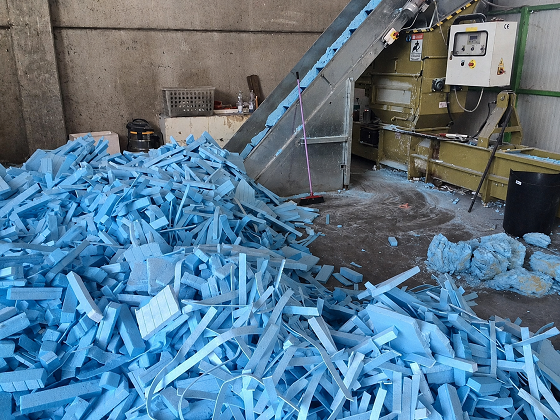
XPS waste is generated at several points across the Australian building and insulation supply chain:
• Insulation-board manufacturing: clean edge trims, rejected sheets and start-up waste.
• Building-material distribution: damaged stock, returns and obsolete board sizes.
• Roofing and insulation installation: cut-offs created when boards are fitted around walls, services and roof details.
• Cold-storage and refrigerated construction: offcuts from insulated floors, walls and roof systems.
• Prefabricated building and panel production: regular production scraps and rejected components.
• Construction and demolition recycling: separated XPS boards recovered from suitable projects.
Which XPS Waste Is Most Suitable for Recycling?
|
XPS waste type |
Typical condition |
Recommended action |
|
Clean production offcuts |
Usually the easiest material to process because the waste is consistent, dry and generated in one location. |
Collect separately and process directly. |
|
Damaged or returned boards |
Often clean but may include labels, film or light surface contamination. |
Remove obvious non-XPS materials before processing. |
|
Construction cut-offs |
Can be recyclable when separated at the point of installation. |
Use dedicated bags, cages or bins to prevent mixing. |
|
Boards with foil, film or facer layers |
May require additional preparation and acceptance checks. |
Confirm specifications with the recycler or equipment supplier. |
|
Heavily contaminated demolition material |
Mortar, adhesive, soil, timber, asbestos or mixed waste can make recovery difficult or unsafe. |
Do not place directly into a standard XPS recycling stream; assess and classify first. |
Can XPS Foam Boards Be Recycled in Australia?
Yes. Clean and separately collected XPS can be processed through specialised recycling routes. It is not normally suitable for standard kerbside recycling because rigid foam boards are bulky, may be generated as commercial or construction waste, and require equipment and downstream outlets that can handle polystyrene foam.
The available route depends on the state, waste source, contamination level and receiving facility. Businesses should confirm local acceptance requirements before transporting material. For example, NSW waste generators and transporters are responsible for ensuring waste is taken to a facility that can lawfully accept it. A site-specific waste-management plan, accurate records and clear material separation can reduce compliance and contamination risks.
Australia does not have a single nationwide ban covering every use of XPS foam. The practical priority for businesses is to reduce avoidable waste, separate recoverable material and establish a lawful recycling pathway rather than mixing clean XPS with general construction waste.
How to Recycle XPS Foam Boards: Step by Step
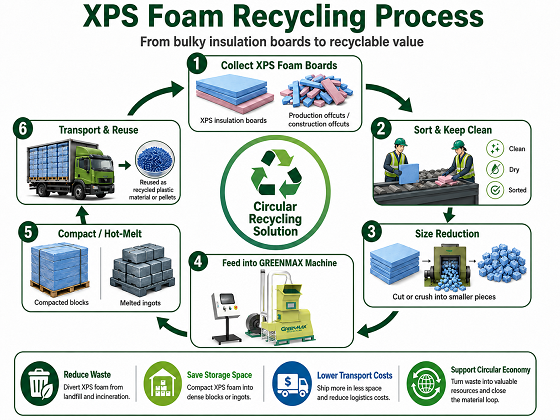
1. Collect XPS separately: Place clean board offcuts in dedicated cages, bags, stillages or covered areas close to where the waste is generated.
2. Separate other materials: Keep XPS apart from EPS, EPE, EPP, timber, metal, plasterboard, general rubbish and potentially hazardous construction materials.
3. Keep the material clean and dry: Remove loose labels, tape, film and other visible contaminants where practical. Prevent soil, mortar and rainwater contamination.
4. Reduce oversized boards: Large sheets may need cutting or crushing so they can be fed safely and continuously into the recycling machine.
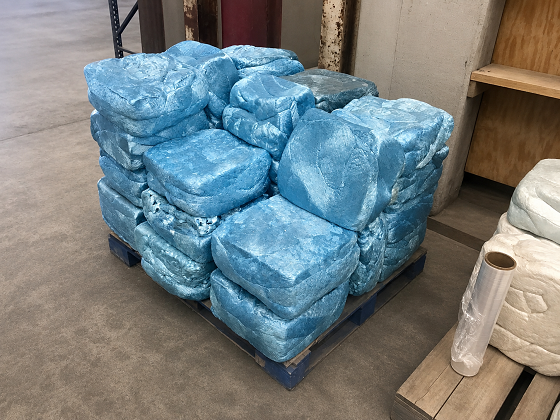
5. Compact or hot-melt the XPS: Use cold screw compression to produce dense blocks, or hot-melting technology to create higher-density ingots.
6. Store and transport the finished output: Stack blocks or ingots safely and transport them to an authorised downstream recycler or an approved GREENMAX recycling channel.
GREENMAX XPS Recycling Machine Options
XPS can be processed by different GREENMAX systems. The best option should be selected according to material size, daily or weekly volume, contamination, labour requirements, available power and the preferred output format.
1. GREENMAX APOLO Cold Compactor
The GREENMAX APOLO Series uses screw pressure to crush and compact XPS without external heating. It is suited to businesses that generate a steady stream of clean insulation-board offcuts and want a practical on-site volume-reduction solution.
• Processes XPS insulation board and other compatible foam materials.
• Produces dense, stackable blocks without hot-melting the material.
• Can achieve a volume-reduction ratio of up to approximately 50:1, depending on material and operating conditions.
• Helps reduce storage space, bin movements and transport frequency.
• Available in different throughput ranges and can be configured around the customer’s waste and site conditions.
2. GREENMAX MARS Hot Melter
The GREENMAX MARS Series crushes, heats and extrudes XPS into dense ingots. Hot melting is useful when the business wants maximum volume reduction and a higher-density output for storage or longer-distance transport.
• Suitable for XPS and several other compatible polystyrene foam materials.
• Combines crushing, melting and extrusion in one process.
• Can reduce foam volume by up to approximately 90:1, depending on the feed material and operating conditions.
• Produces hard, dense ingots after cooling.
• Available in multiple capacities for different waste volumes.
3. Foam Crusher or Size-Reduction Equipment
Very large boards, thick sheets or irregular scraps may benefit from pre-crushing or cutting before densification. A correctly selected crusher improves feeding consistency and can reduce manual handling. The need for separate size-reduction equipment depends on the machine configuration and the dimensions of the incoming XPS.
Cold Compactor or Hot Melter: Which Is Better for XPS?
|
Factor |
APOLO cold compactor |
MARS hot melter |
|
Processing method |
Mechanical screw compression without external heating |
Crushing, heating and extrusion |
|
Typical output |
Dense compacted blocks |
High-density melted ingots |
|
Indicative volume reduction |
Up to approximately 50:1 |
Up to approximately 90:1 |
|
Energy profile |
Generally lower because the material is not hot-melted |
Higher due to the heating process |
|
Best suited to |
Regular clean offcuts, local storage and transport reduction |
Maximum densification and longer-distance transport |
|
Odour and heat |
No hot-melting process |
Requires heat management and suitable ventilation |
|
Selection factors |
Waste size, throughput, output stability and downstream requirements |
Waste volume, energy supply, output value and downstream requirements |
Neither process is automatically better in every situation. The correct choice should be based on a waste sample, expected throughput, plant layout, power availability and the specifications accepted by the downstream recycler.
Business Benefits of Recycling XPS Foam
Reduce occupied space. Loose XPS boards can quickly fill cages, skips and warehouse areas. Densification turns a high-volume waste stream into a compact output.
Lower handling and freight requirements. Fewer collections and better payload utilisation can reduce the cost of moving lightweight foam.
Improve site organisation. A defined collection and processing area supports cleaner storage, safer movement and better 5S practices.
Create a measurable recycling stream. Weighed blocks or ingots are easier to record than loose foam and can support internal waste reporting.
Protect clean material from contamination. A dedicated process encourages staff and contractors to keep recoverable XPS separate from mixed construction waste.
Support circular use of polystyrene. Suitable processed material can enter downstream recycling and be converted into recycled plastic feedstock or new products.
GREENMAX Buy-Back and Downstream Recycling Support
GREENMAX combines equipment supply with downstream recycling support. Where the material meets required specifications and a suitable collection route is available, GREENMAX can discuss the purchase or recovery of compacted blocks and hot-melted ingots.
Buy-back availability is not automatic. It depends on material type, contamination, colour, output quality, quantity, location, packaging and current downstream demand. Before relying on a recycling outlet, businesses should obtain written confirmation of the required material specification and commercial terms.
Frequently Asked Questions
Can XPS foam boards be recycled in Australia?
Yes. Clean and separately collected XPS can be processed through specialised recycling routes. Acceptance depends on the material condition, quantity, location and the requirements of the receiving recycler.
Can XPS foam go in a kerbside recycling bin?
XPS insulation boards are generally not suitable for standard kerbside recycling. Businesses should use a specialised collection, compaction or recycling route.
What is the difference between XPS and EPS?
Both are polystyrene foams, but XPS is extruded into rigid closed-cell insulation board, while EPS is usually moulded from expanded beads and is widely used for packaging, fish boxes and insulation.
What machine can recycle XPS insulation boards?
XPS boards can be reduced with a crusher or cutter and processed using a GREENMAX cold compactor or hot melting machine. The suitable configuration depends on board size, waste volume, site conditions and required output.
Is cold compaction or hot melting better for XPS?
Cold compaction produces dense blocks without hot melting and generally uses less energy. Hot melting produces higher-density ingots. The better option depends on waste volume, power, freight distance and downstream specifications.
Can contaminated XPS boards be recycled?
Light labels or removable film may be manageable, but mortar, adhesive, soil, timber, metal, asbestos or mixed demolition waste can prevent acceptance. Contaminated material must be assessed and managed in accordance with local waste requirements.
Is XPS foam banned in Australia?
There is no single nationwide ban covering every XPS application. Requirements vary by state, use and waste stream. Businesses should focus on lawful management, source separation and available recycling routes.
Can GREENMAX buy compacted or melted XPS?
GREENMAX can discuss downstream recycling or buy-back options where the processed material meets required specifications. Availability depends on material quality, quantity, location, logistics and current market conditions.