 Select Languange
 English
 Spanish
 Polish
 Japanese
 Italian
 French
How to Recycle Packaging Peanuts in Australia | EPS Loose Fill Recycling Solution
Packaging peanuts (also known as EPS loose fill) are widely used in logistics and e-commerce packaging. While they provide excellent cushioning, they are difficult to recycle through standard kerbside systems in Australia.
Packaging peanuts are typically made from Expanded Polystyrene (EPS), a lightweight plastic material. There are also biodegradable starch-based alternatives. EPS peanuts do not dissolve in water and are not compostable, while biodegradable types may dissolve or break down under specific conditions.
This article explains how packaging peanuts can be managed, reused, or recycled, and introduces an industrial solution for businesses.
| Type of packaging peanuts | How to identify | Recycling advice |
|---|---|---|
| EPS / polystyrene peanuts | Lightweight, static cling, does not dissolve in water | Reuse first; for businesses, collect clean and dry material for compaction or hot melting |
| Biodegradable starch peanuts | Dissolves or softens in water | Usually compostable or dissolvable, but should not be mixed with EPS recycling |
| Mixed / contaminated peanuts | Wet, dusty, mixed with tape, labels, food residue | Separate or remove contamination before recycling |
Can Packaging Peanuts Be Recycled in Australia?
In most Australian kerbside recycling systems, EPS packaging peanuts are not accepted. They are lightweight, easily contaminated, and difficult to process in material recovery facilities. However, clean EPS peanuts can sometimes be reused or sent to specialised recycling facilities.
Recycling Context in Australia
Australia is actively reducing problematic plastics under national packaging targets and APCO guidelines. EPS loose fill is increasingly discouraged due to its environmental impact and low recycling efficiency. Some states have also introduced restrictions on certain EPS packaging types.
Key Recycling Challenges
The main challenges include high volume, low weight, contamination risks, and transport inefficiency. As a result, businesses often face high disposal costs and limited recycling options.
GREENMAX Recycling Solution for EPS Packaging Peanuts
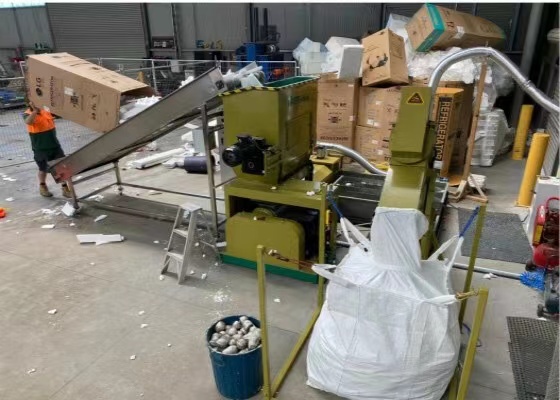
For businesses generating large volumes of packaging peanuts, volume reduction is the key step. GREENMAX provides industrial foam recycling equipment that compacts or melts EPS into dense blocks, significantly reducing storage and transport costs.
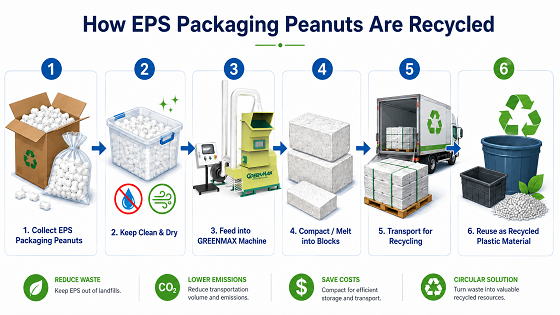
Recycling Process Overview
1. Collect EPS packaging peanuts
2. Keep material clean and dry
3. Feed into GREENMAX machine
4. Compact or melt into blocks
5. Transport compacted material
6. Reuse as recycled plastic raw material
Frequently Asked Questions (FAQ)
Q: Can packaging peanuts go into recycling bins?
A: In most cases, no. EPS peanuts are not accepted in kerbside recycling in Australia.
Q: Are all packaging peanuts made from plastic?
A: Most are EPS plastic, but some are biodegradable starch-based materials.
Q: What should businesses do with large volumes of EPS peanuts?
A: Businesses should collect them separately and use compaction or melting equipment to reduce volume before recycling.
Q: How does GREENMAX help?
A: GREENMAX provides foam recycling machines that compress EPS waste into dense blocks for easier transport and recycling.