 Select Languange
 English
 Spanish
 Polish
 Japanese
 Italian
 French
Foam Recycling – What You Can Do and Where to Recycle
Can Foam Be Recycled?
Yes. Foam is a type 6 plastic and can be recycled, although suitable foam recycling facilities are not available in every area. Many local councils do not accept foam in kerbside recycling and instead ask residents to place it in the general waste bin rather than the yellow-lid recycling bin.
This is unfortunate because foam still has reuse value. Once processed, the recovered material can be used to manufacture products such as CD cases, cutlery and plastic furniture, helping reduce landfill waste and the demand for virgin petrochemical resources.
In Australia, however, there are still a number of options available for recycling foam.
Sydney and Melbourne Foam Recycling Drop-off Points
In Sydney and Melbourne, many local councils provide foam recycling drop-off points. Collected foam is sent into dedicated recycling streams rather than treated as general waste.
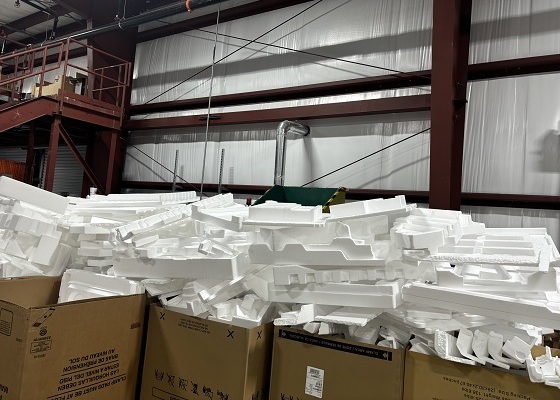
In Australia, EPS foam usually needs to be taken to a designated collection point instead of being placed in household recycling bins. Sources of foam recycling material include residential drop-off points, manufacturers, local councils, commercial businesses and construction sites.
Once collected, the material is generally sorted and contaminants such as labels and adhesive are removed. It can then go through processes such as shredding, compaction and pelletising.
After processing, EPS can be turned into recycled plastic raw material and used to manufacture products such as building insulation, extruded polystyrene boards, skirting boards, picture frames and outdoor furniture.
To find a nearby Sydney foam recycling drop-off point, please visit:
http://recyclingnearyou.com.au/polystyrene/SydneyNSW
To find a nearby Melbourne foam recycling drop-off point, please visit:
http://www.sustainability.vic.gov.au/www/html/3658-polystyrene-recycling.asp
Industrial Foam Recycling in Australia
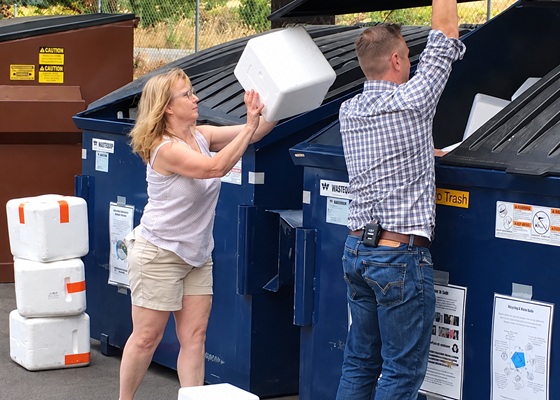
Foam can be recovered at several stages of its lifecycle. Offcuts generated during production can be returned to the manufacturing process and used in new foam products, while construction offcuts can also be collected and reused.
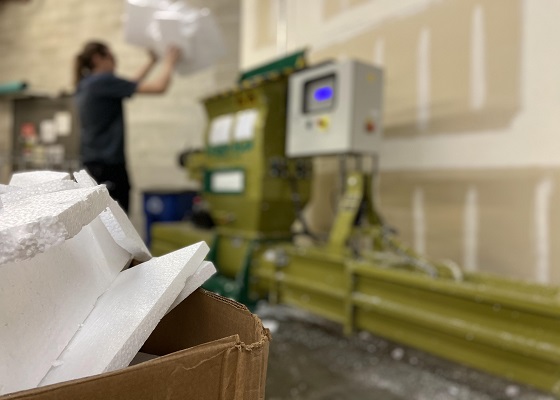
GREENMAX supplies foam recycling equipment and works with Australian businesses to collect and transport unused or end-of-life foam before it is sent for pelletising and reuse. More than 90% of foam volume is air, so compaction or melting can remove much of that air and significantly reduce the material volume, making transport and further processing more practical.
For businesses that regularly generate large quantities of foam waste, volume reduction is often an important part of the recycling process. Foam recycling equipment can reduce the space required for loose foam and make bulk transport more economical. In Victoria, cold compaction, thermal processing and the centralised collection of loose EPS are also among the processing approaches used in practice.
GREENMAX Foam Recycling Equipment
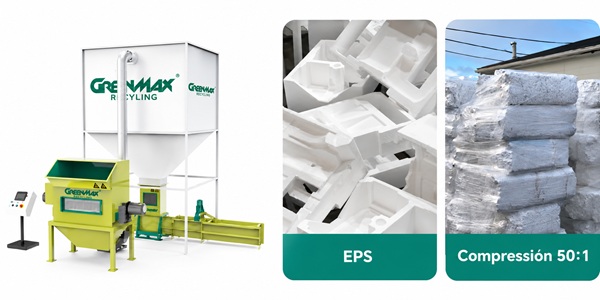
1. Screw Compaction System – 50:1 Compression Ratio
The foam is first shredded and then repeatedly compacted under mechanical pressure from the screw. Cold-compacted blocks are suitable for downstream pelletising and further reuse.
| ITEM | A-C100 |
| Total Power Consumption | 10.25 kW / 13.75 hp |
| Crusher Power Consumption | 2.2 kW / 2.95 hp |
| Production Capacity | 100 kg per hour / 220 lbs per hour |
| EPS Compression Ratio | 50:1 |
| Compressed EPS Density | 200-400 kg/m³ / 570-1140 lbs/cubic yard |
| EPS Block Dimensions | 300*300 (w/h) mm / 11.8*11.8 (w/h) in. |
| Feed Hopper Door | 800*515 (l/w) mm / 31.5*20.3 (l/w) in. |
| Dimensions | 3900*650*2010 (l/w/h) mm / 153.5*25.6*79.1 (l/w/h) in. |
| Weight | 1,500 kg / 3,300 lbs |
If you would like to learn more about GREENMAX EPS Compactor models,please click here.
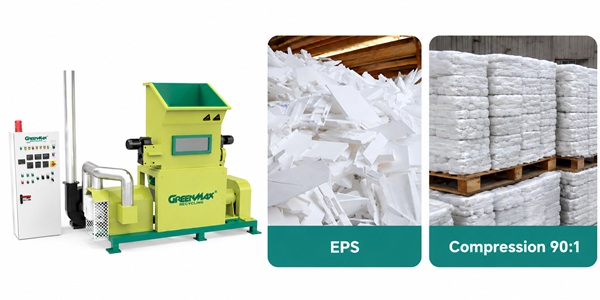
2. High-Temperature Melting System – 90:1 Compression Ratio
The foam is evenly shredded before entering the high-temperature melting system, where the material is softened into a semi-fluid state and continuously extruded by the screw. The higher volume reduction allows more material to be loaded into each shipment, making it more suitable for long-distance transport.
| ITEM | M-C100 |
| Motor Power | 22.9 kW / 30.6 hp |
| Production Capacity | 100 kg per hour / 220 lbs per hour |
| EPS Compression Ratio | 90:1 |
| Compressed EPS Density | 600-800 kg/m³ / 1320-1750 lbs/cubic yard |
| Feed Hopper Door | 800*555 (l/w) mm / 31.5*21.9 (l/w) in. |
| Dimensions | 2030*1430*2040 (l/w/h) mm / 79.9*56.3*80.3 (l/w/h) in. |
| Weight | 1,500 kg / 3,300 lbs |
If you would like to learn more about GREENMAX Polystyrene Melting Machine models,please click here.