 Select Languange
 English
 Spanish
 Polish
 Japanese
 Italian
 French
Expandable Polyethylene (EPE) Recycling for the Solar PV Industry
As global Solar PV deployment accelerates, manufacturers, module assemblers, EPCs, and distributors face a growing challenge: what to do with increasing volumes of Expandable Polyethylene (EPE) foam used to protect modules, inverters, and delicate balance-of-system components. Landfilling this lightweight, voluminous material is costly and environmentally counterproductive. The good news is that EPE is recyclable—and with the right equipment and logistics, it can be transformed from a disposal liability into a valuable raw material.
GREENMAX provides a proven, end-to-end EPE recycling solution tailored to the Solar PV supply chain. We also offer FREE consultation and custom solution design to help you start quickly and confidently. Throughout this article we use Solar PV, PV, and photovoltaic interchangeably to match industry terminology and search behavior.
Why EPE Waste Is a Pain Point in Solar PV Logistics
EPE is an expanded form of polyethylene that offers excellent cushioning, shock absorption, and surface protection. It’s ubiquitous in module corners, edge protectors, spacers, inverter packaging, junction-box kits, and delicate component trays. After unpacking, these foams occupy enormous space in warehouses and yards, driving up on-site handling and disposal costs. Common pain points include:
High volume, low density: EPE fills trailers and containers long before reaching weight limits, inflating transport costs.
Inconsistent waste streams: Mixed shapes and densities complicate storage and downstream handling.
Sustainability targets: Solar PV enterprises must demonstrate landfill diversion, recycling rates, and compliance with buyer and regulatory expectations across Europe and North America.
The GREENMAX Approach to EPE Recycling
1) On-site Volume Reduction
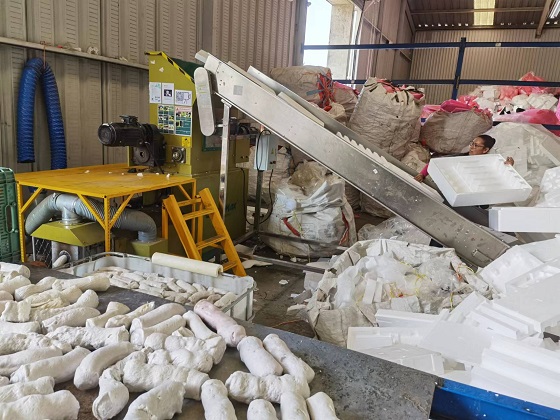
Our Polyethylene melting machine reduces EPE volume dramatically by melting and densifying loose foam into compact blocks or logs.
Melting/Densification: Converts lightweight foam into stable, high-density forms, cutting transport volume by 90%+.
Operator-friendly design: Built for continuous industrial use with intuitive controls and safety features.
Flexible throughput: Match capacity to your current EPE generation rate, with room to scale as Solar PV output grows.
2) Smart Storage & Backhaul
After melting and densification, material is stackable and stable, enabling efficient palletization, container loading, or backhaul via your existing logistics network. This immediately reduces warehouse congestion and transportation costs for PV facilities with fluctuating project cycles.
3) Circular Re-Use Pathways
Densified EPE can be granulated and reprocessed into high-value polyethylene applications (e.g., protective profiles, piping blends, packaging components, or molded parts), creating a closed-loop pathway and supporting corporate circularity goals within the photovoltaic sector.

What Makes GREENMAX Different
Solar PV-specific know-how: Our team understands module packing formats, receiving workflows, and seasonal demand cycles.
Turnkey integration: From site survey to layout, power & safety planning, operator training, and SOPs—we design for your reality.
Compliance across markets: Documentation and practices support operations in European and American markets, aligning with local EHS expectations and recycling reporting needs.
Data for ESG: Track diversion rates, weights, and shipment records to support sustainability reporting and PV customer audits.
Typical Implementation Timeline (Fast & Practical)
FREE Consultation & Waste Audit: Share photos, volumes, and current handling methods. We evaluate your EPE types, peaks, and storage constraints in a PV context.
Custom Solution Design: We specify Polyethylene melting machine model(s), floorplan, electrical needs, material flow, and staffing.
Pilot & Training: Commission equipment, train operators, and fine-tune block/log specs for downstream buyers.
Steady-State Operations: Establish regular pickups or backhaul schedules, capture data for ESG reporting, and expand capacity as volumes grow.
Benefits Solar PV Companies Can Expect
Up to 90%+ volume reduction lowers freight and storage costs.
Landfill diversion and improved sustainability metrics for photovoltaic operations.
Cleaner warehouses and safer handling around unpacking lines.
Potential revenue stream from densified PE feedstock, depending on market conditions and quality.
Scalable systems that grow with your production or distribution footprint.
Use Cases Across the PV Chain
Module Manufacturing: Continuous streams of corner protectors and spacer foams—ideal for on-line melting/densification near unpacking stations.
Distribution Centers: Mixed EPE returns from multiple OEMs—melting/densification normalizes the waste for uniform logistics.
Project Sites & EPC Yards: Temporary high volumes during build phases—mobile or compact Polyethylene melting machines keep sites organized and reduce haul-offs.
Start With a FREE Plan from GREENMAX
Every facility is different. That’s why we begin with no-cost consulting and a custom solution design aligned to your space, volumes, and ESG targets. Whether you are setting up a single line at a module plant or a network of systems across multiple DCs, we’ll help you turn Solar PV packaging foam from a problem into a predictable circular material flow—fast.
Ready to reclaim space, lower costs, and hit your recycling goals? Contact GREENMAX today for your FREE consultation and solution design.
FAQs
Is EPE foam from Solar PV packaging actually recyclable?
Yes. EPE (Expandable Polyethylene) is a recyclable polyolefin. With proper melting and densification using a Polyethylene melting machine, it can be reprocessed into useful PE products for photovoltaic supply chains.
What equipment do I need to start?
Most PV facilities start with a Polyethylene melting machine sized to their weekly EPE volume. GREENMAX specifies the right model, layout, and operating procedures during your free consultation.
Will the recycled EPE have a reliable outlet?
Densified EPE is a recognized feedstock. We help align downstream buyers or internal reuse pathways depending on your quality, logistics, and regional market conditions.
How quickly can we see ROI?
Savings usually come from reduced storage and transport, avoided disposal fees, and potential material value. Timelines vary by volume and logistics; we’ll model this in your free solution design.