 Select Languange
 English
 Spanish
 Polish
 Japanese
 Italian
 French
COLOMBIAPLAST 2026 wrap-up: GREENMAX signs two polystyrene melting machines in Colombia
At the stand: referrals from regulars, agreements with newcomers
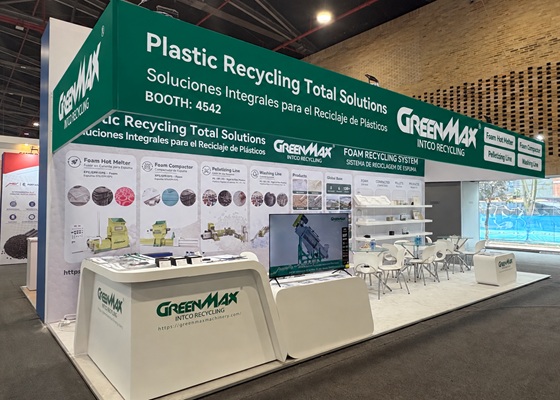
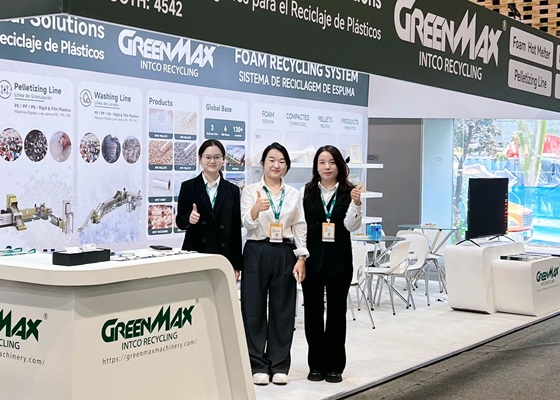
Five days of show. Stand 4542 welcomed plenty of visitors — some meeting us for the first time, others already familiar with our machines; everyone deserves thanks for the trust. The two contracts closed — an M-C50 and an M-C200 — grew out of long conversations and shared decisions.
Against the Colombian reality, where more than 80% of EPS goes straight to landfill, GREENMAX brought more than a piece of foam recycling equipment: it brought a complete polystyrene recycling service — solution design, machinery, and buyback of the compacted blocks.
EPS recycling: an alternative to landfill
In Colombia, polystyrene goes by a local name: icopor. Around the halls, many visitors were hearing for the first time that polystyrene can actually be recycled — compacted, granulated, reused — and that across most of the country, polystyrene waste still ends up in landfill; working collection channels exist today almost exclusively in Bogotá.
EPS takes up plenty of space while weighing little, so storing and moving it untreated gets expensive. A polystyrene melting machine that reduces the volume right where the waste is generated turns loose foam into high-density blocks, ready for transport, sale and reprocessing.
And the question arrives quickly, and it is practical: who buys the blocks? GREENMAX runs a closed loop that gives compacted blocks a stable outlet: EPS recycling solution design → compaction equipment → buyback of the blocks. The repurchased material returns as wall panels and picture frames, and the plastic waste stream shrinks a little more. Australian recyclers will recognise the model — a structured buyer for compacted EPS blocks is the part of the chain most operations struggle to find on their own.
The Colombian pain point: energy
Blackouts and power rationing through the dry season, high electricity tariffs, the cost of every restart, and pressure on the carbon footprint: at the stand, these words came up again and again. Anyone running machinery in Australia will recognise them straight away — electricity prices have been a running theme for Australian industry, and the maths on a machine that idles and restarts all day is unforgiving.
The GREENMAX answer:
the polystyrene melting machine M-C50 draws just 7.5 kW yet compacts polystyrene up to 90 times, into blocks of 600–800 kg/m³ density; it covers two tonnes of waste a month and takes up little more space than a carton.
For 3–5 tonnes monthly there is the standard M-C100 at around 22.9 kW.
And for those combining low consumption with higher throughput, the A-C100 of the Apolo series — cold-compaction foam recycling equipment — processes a tonne in around 10 hours at about 10 kW.
| Model | Mars series (thermal melting) | Apolo series (cold compaction) | ||
|---|---|---|---|---|
| Specification | M-C50 | M-C100 | M-C200 | A-C100 |
| Total power consumption | 9.7 kW | 25.1 kW | 37.5 kW | 10.25 kW |
| Capacity | 50 kg/h | 100 kg/h | 200 kg/h | 100 kg/h |
|
Daily processing (reference)
(at 8 h/day)
|
0.4 t | 0.8 t | 1.6 t | 0.8 t |
| Compaction ratio | 90:1 | 90:1 | 90:1 | 50:1 |
The stories behind the two contracts
The polystyrene melting machine M-C50 went to an EPS cutting and processing company: its line already feeds milled material back into production, but a considerable volume of EPS dust remained. A long-standing GREENMAX customer referred the company, and before long the EPS recycling concept and block buyback were agreed — machine quality and a stable buyback channel made the difference.
The M-C200 went to a Bogotá company in solid waste recovery and plastics reprocessing, running the full chain: sorting, granulation and injection moulding, around 200 tonnes a month. Its EPS stream sits at just 2–3 tonnes a month, which its current agglomeration process cannot handle; the plan is to process shredded EPS through a melting machine. Between two capacity classes — 100 kg/h (M-C100, 22.9 kW, one tonne in roughly 10 hours) and 200 kg/h (M-C200, 37.5 kW, one tonne in roughly 5 hours) — the company chose the larger. One more fact carried weight: GREENMAX machines have been running stably in Colombia for more than 15 years.
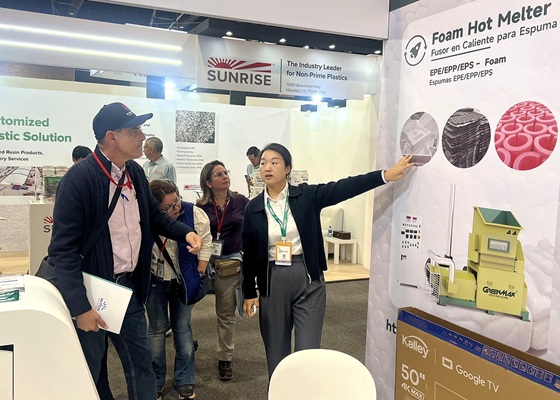
The Mars series sells on simple operation and high block density. What GREENMAX wants Colombian recyclers — and not only them — to know is that polystyrene is worth recycling, and that someone takes responsibility from start to finish: from choosing the polystyrene melting machine to buying back the blocks, all from one source. Whether you run an EPS processing plant or work as a polystyrene recycler, the invitation to get in touch stands. The show has wrapped up; the collaboration is only beginning.