 Select Languange
 English
 Spanish
 Polish
 Japanese
 Italian
 French
IFAT Germany 2026: What Australian Businesses Can Learn About Foam Recycling and Circular Packaging
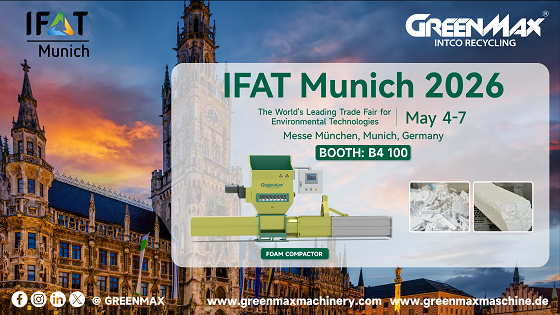
IFAT Munich 2026 is one of the most important international events for companies following waste management, recycling and circular economy technology. Taking place in Munich, Germany from 4 to 7 May 2026, the exhibition focuses on water, recycling and circularity, bringing together more than 3,000 exhibitors from over 60 countries. For Australian businesses that generate bulky EPS, EPE, EPP or other foam packaging waste, IFAT is a practical signal of where the global recycling industry is moving: from disposal-led waste handling to on-site volume reduction, cleaner material streams and measurable recovery outcomes.
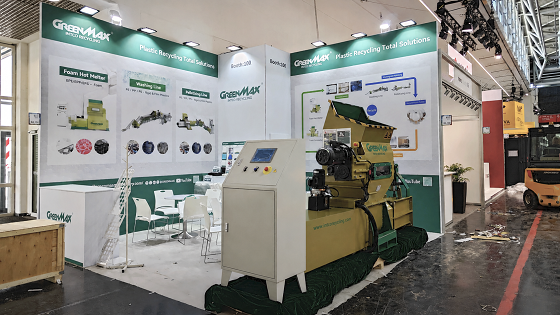
GREENMAX is using this industry moment to highlight foam recycling systems that help manufacturers, seafood suppliers, appliance retailers, logistics warehouses and packaging users turn light, bulky foam into dense, easier-to-transport blocks or ingots. One important update is that a Brazilian customer placed an order on site for one MC300E, showing strong international demand for high-capacity foam recycling equipment at the exhibition.
Industry development trends shown by IFAT Germany
The recycling industry is moving quickly in five clear directions. First, packaging recovery is becoming a board-level compliance issue rather than a back-of-house waste task. Second, companies are investing in equipment that reduces transport frequency and storage space. Third, recycling buyers increasingly prefer clean, compacted material that can be moved efficiently and reprocessed more predictably. Fourth, policy pressure is pushing businesses to prove that packaging is not only theoretically recyclable but actually collected and recovered. Finally, equipment suppliers are expected to provide turnkey support: machinery, installation, operator training, maintenance and downstream recycling channels.
These trends matter in Australia because distance is a major cost factor. A pallet or cage full of loose EPS can occupy large warehouse space while containing very little actual plastic by weight. Without densification, businesses may pay to transport air. This is why on-site foam compaction or hot melting is becoming more relevant for Australian operators with regular foam volumes.
Australian policy direction: packaging must be recoverable and circular
Australia is reforming packaging regulation to improve environmental outcomes, support the transition to a circular economy, drive investment in packaging design and recovery systems, minimise waste, and support circular economy industries and jobs. The Australian Government has stated that packaging available in Australia should be designed in line with circular economy principles so it can be recovered, reused, recycled and safely reprocessed.
EPS remains a visible challenge. APCO has identified expanded polystyrene used in electronics and appliance packaging as persistent because it is lightweight and protective but difficult for consumers to recycle through normal channels. For businesses, this creates a clear opportunity: rather than treating EPS as general waste, commercial operators can separate foam at source, reduce its volume on site and prepare it as a recyclable material stream.
Why foam waste is generated
Foam materials such as EPS, EPE and EPP are widely used because they are light, shock-absorbing, insulating and cost-effective. They protect appliances, furniture, electronics, seafood, fresh produce, automotive parts and construction products during storage and transport. Foam waste is generated when goods are unpacked, when packaging offcuts are produced in manufacturing, when damaged insulation panels are removed, or when reusable transport packaging reaches the end of its service life.
The material itself is not the main problem. The problem is its form. EPS and similar foams are made with a very high proportion of air, so loose foam takes up large volume while carrying low weight. This creates handling, transport and recycling barriers unless businesses densify it before collection.
Pain points for Australian foam waste generators
Typical pain points include overflowing bins, high waste collection frequency, wind-blown particles around loading areas, contamination from mixed waste, high transport cost per tonne, limited storage space and difficulty finding stable recycling outlets for loose foam. For retailers and warehouses, foam also affects site cleanliness and workplace efficiency. For manufacturers, foam offcuts can interrupt production areas if they are not removed and processed quickly.
From a sustainability perspective, sending foam to landfill also weakens ESG reporting. Businesses are being asked by customers, councils and supply-chain partners to show how packaging waste is handled. A compacted or melted foam stream is easier to record, store and sell or send to a recycler than loose mixed waste.
GREENMAX recycling solution for EPS, EPE and EPP foam
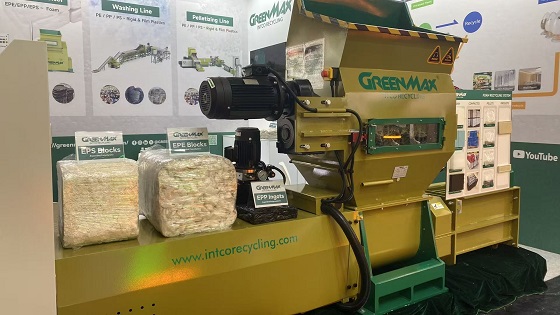
GREENMAX provides foam recycling equipment designed to convert loose foam into dense, transportable material. For companies with higher foam volumes, the GREENMAX MARS C300 / MC300E hot melting densifier is a strong option. The system crushes foam, heats and plasticises it through screw melting technology, and extrudes dense ingots that are easier to store and ship. GREENMAX product information notes that Mars C300 can process EPS, EPE and EPP pieces, includes a large pre-crusher and silo system, and is built for higher-capacity recycling operations.
For Australian businesses, the solution can be positioned around four benefits: lower waste transport cost, better warehouse space utilisation, cleaner waste handling and improved recyclability. GREENMAX can also support customers with material buy-back and recycling channels, helping companies move from “waste disposal” to “resource recovery”.
Why the Brazilian MC300E on-site order matters
The Brazilian customer’s on-site order for one MC300E at IFAT Germany is a useful trust signal for Australian buyers. It shows that foam recycling challenges are not limited to Europe. Businesses in different regions face the same core issue: bulky foam is expensive to move unless it is compacted or melted at source. The order also demonstrates market confidence in GREENMAX equipment for industrial foam recycling applications.
Conclusion
IFAT Germany 2026 confirms that circular packaging is becoming a practical requirement for global businesses. For Australian companies handling EPS, EPE or EPP packaging waste, the next step is not only to look for a recycler but to make foam recyclable before it leaves the site. GREENMAX foam recycling systems, including MC300E, help reduce volume, control logistics cost and prepare waste foam for reuse in the recycling market.
FAQ
What is IFAT Germany 2026?
IFAT Munich 2026 is a leading international trade fair for environmental technologies, with a focus on water, recycling and circularity. It takes place in Munich, Germany from 4 to 7 May 2026.
Why is foam difficult to recycle in Australia?
Foam such as EPS, EPE and EPP is very light and bulky. Loose foam takes up large storage and transport space, is easily contaminated and is often unsuitable for normal kerbside recycling systems.
How does GREENMAX MC300E help recycle foam?
GREENMAX MC300E crushes and hot-melts waste foam into dense ingots, reducing volume and making the material easier to store, transport and send for recycling.
Which industries can use a GREENMAX foam recycling machine?
Appliance retailers, seafood suppliers, packaging manufacturers, warehouses, furniture companies, automotive suppliers and construction product companies can use GREENMAX equipment if they generate regular foam waste.
Can GREENMAX support downstream recycling?
Yes. GREENMAX can support foam recycling projects with equipment selection and recycling channels, including buy-back or material recovery support where available.