 Select Languange
 English
 Spanish
 Polish
 Japanese
 Italian
 French
Custom EPP & EPO Recycling Solution for Automotive Industry: Introducing GREENMAX MC300E System
Meeting the Demands of High-Density Foam Recycling in Japan
The automotive industry in Japan is known for its precision, sustainability commitment, and high-quality manufacturing standards. In recent years, automotive OEMs and parts suppliers have increasingly focused on the recycling of high-density expanded foams such as EPP (Expanded Polypropylene) and EPO (Expanded Polyolefin) — materials widely used in bumper cores, crash pads, and energy absorption components.
However, recycling high-density EPP and EPO poses unique challenges: the foams are resilient, slow to collapse, and prone to bridging during storage and feeding. Addressing this market gap, GREENMAX has launched a new, fully customized system — the MC300E, purpose-built for high-efficiency EPP/EPO recycling with minimal labor requirements.
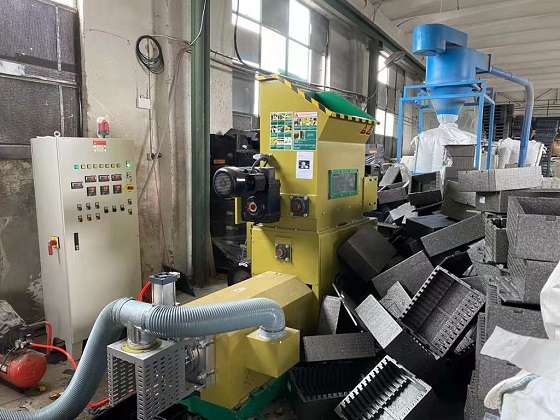
GREENMAX MC300E: Engineered for Custom Performance
The MC300E is not just another foam densifier — it is an advanced, tailor-made recycling system co-developed with Japanese automotive clients. Here's how it stands out:
Twin Crushing System
To handle high-density, tough-to-break foam materials like EPP/EPO, MC300E is equipped with two-stage crushing mechanisms. The first stage reduces large foam blocks into manageable fragments, while the second ensures uniform fine particles before entering the heating zone — crucial for consistent melting and compaction.
Anti-Bridging Silo System with Mixing Function
Bridging — the tendency for foam chunks to clump and clog in silos — is a major issue with resilient foam. MC300E combats this using a silo system with active agitation (mixing blades) to prevent material jamming and ensure steady feed into the melting chamber. This innovation greatly improves reliability and automation.
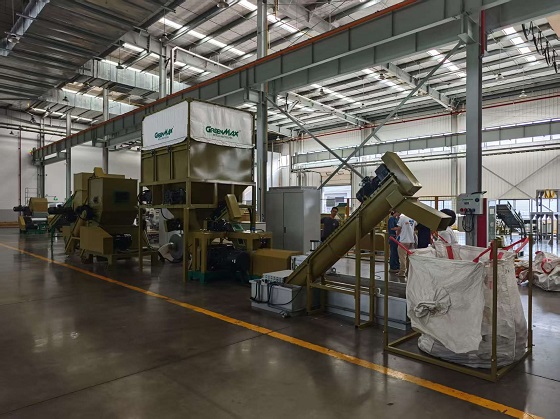
Water-Cooling and Auto-Cut Function
After compaction, the material is extruded into solid bars, which are then cut automatically into uniform lengths. To maintain material integrity and avoid warping, these compacted bars are immediately passed through a water-cooling trough, ensuring a stable shape and easy stacking for transport or resale.
Fully Automatic Baling System
The cooled and cut recycled bars are then collected and automatically baled into stacks — without manual intervention. The entire post-melting process is automated, improving both efficiency and output consistency.
One-Person Operation, Zero Compromise on Output
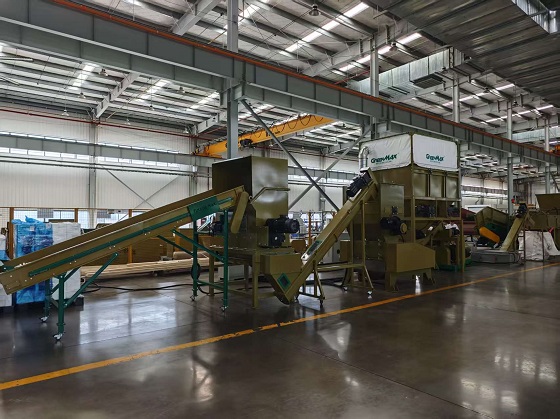
One of the standout advantages of the MC300E system is its labor-saving design. While many recycling systems require 2–3 operators, MC300E is engineered for one-person operation, thanks to full automation from feeding to final baling. This meets the needs of high-labor-cost regions like Japan, where automation is not just desirable — it's essential.
Customization Is the GREENMAX Advantage
The development of MC300E demonstrates GREENMAX’s deep customization capability, backed by years of engineering experience in foam recycling technology. Whether it’s material behavior (EPP vs. EPE vs. EPS), regional standards, or plant layout constraints, GREENMAX offers bespoke systems that align precisely with customer needs.
Designed for Sustainability and Circular Economy
With EPP and EPO being fully recyclable materials, GREENMAX’s solution helps automotive clients close the loop by reducing landfill waste and transforming foam scraps into high-value recycled materials. The compacted ingots or blocks produced by MC300E can be resold or reprocessed into plastic pellets for reuse in manufacturing — supporting zero-waste and carbon reduction goals.
Ideal for:
Automotive factories in Japan and globally
Foam molding plants handling EPP/EPO packaging
Recyclers focusing on industrial foam materials
Logistics providers seeking efficient foam waste management
Contact GREENMAX for Your Customized Solution
If your company handles tough EPP/EPO recycling tasks, the GREENMAX MC300E may be the ultimate one-stop solution. From engineering consultation to post-sales support, our team provides localized service, parts, and buy-back programs for densified foam blocks.