
 Select Languange
 English
 Spanish
 Polish
 Japanese
 Italian
 French
Australia Solar Industry Trends, Policy, and Packaging Recycling Solutions
Australia’s solar industry has moved from rapid expansion into a phase of long-term structural importance. In the first half of 2025 alone, 115,584 rooftop solar systems were installed across the country, lifting Australia to 4.2 million rooftop installations and 26.8 GW of cumulative rooftop solar capacity. Rooftop solar also supplied 12.8% of Australia’s electricity generation in that half-year, after contributing 12.4% across full-year 2024.
The market is also shifting from solar-only adoption to solar-plus-storage. The Clean Energy Council reports that Australia sold a record 183,245 home batteries in the second half of 2025 alone, bringing total household battery installations to 454,753 by year-end. At the same time, industry analysis from SunWiz shows commercial and industrial solar grew strongly in 2024, even as residential installations softened and large-scale solar projects continued to face cost and delivery headwinds.
Key government policies supporting the Australian solar market
Government policy remains a major force behind this momentum. The Australian Government says the country has the capability to reach 82% renewable electricity by 2030. For households and small businesses, the Small-scale Renewable Energy Scheme supports eligible systems through small-scale technology certificates, or STCs, for rooftop solar and batteries. For large-scale investment, the Capacity Investment Scheme is designed to accelerate renewable generation and dispatchable storage, with the federal government targeting an additional 40 GW of capacity by 2030, including 26 GW of renewable generation.
Policy support is also broadening into storage and manufacturing. The Department of Climate Change, Energy, the Environment and Water says changes to the Cheaper Home Batteries Program commence on 1 May 2026 through battery STCs, while ARENA’s Solar Sunshot program commits up to $1 billion to build Australian solar PV manufacturing capability and strengthen local supply chains.
Why foam and bubble packaging is generated in the solar industry
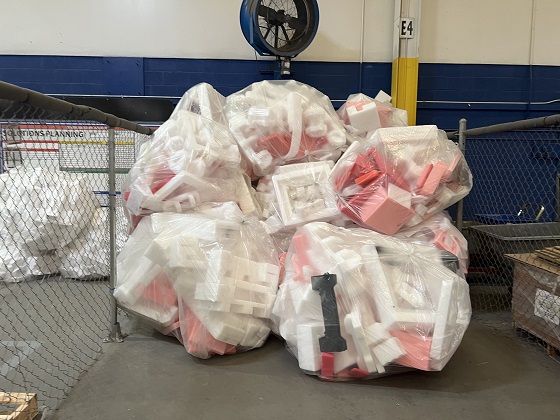
Foam and bubble packaging are generated because solar products are valuable, fragile, and exposed to demanding transport conditions. A U.S. Department of Energy logistics presentation on solar modules explains that solar modules are large and flat, respond differently to mechanical vibration during transport, and face their most mechanically severe environment during distribution. The package system exists to protect the product and prevent damage. In commercial packaging practice, solar shipments commonly use stretch film, banding, corner protectors, module spacers, bubble wrap, foam inserts, and corrugated boards.
As Australia installs more panels, batteries, inverters, and balance-of-system equipment, the volume of packaging waste rises with the market. Green Clean Solar notes that large-scale solar projects create large-scale waste, and that mixed-material packaging becomes a backend recycling problem because items such as plastic straps with metal staples are difficult to separate economically. That means a product designed to support clean energy can still create a messy waste stream once it reaches the warehouse or job site.
Main pain points caused by solar packaging waste
One major pain point is soft-plastic recovery. In Australia, bubble wrap is classified as a soft plastic, and Recycling Near You says that for most Australians there is no soft-plastic recycling service at present, so bubble wrap and similar materials generally go to general waste unless a specialised local option exists. The Western Metropolitan Regional Council in WA also warns that bubble wrap and other soft plastics should not go in kerbside recycling because they mix with paper and cardboard bales and make those loads harder to sell.
Another pain point is the nature of EPS and other foam packaging itself. APCO says EPS has limited collection options, is not recyclable through kerbside recycling in Australia, and takes up a disproportionately large amount of space relative to its weight in transport and landfill. NSW EPA estimates that 12,000 tonnes of EPS are disposed of to landfill each year in NSW, taking up 240,000 cubic metres of landfill space. CSIRO’s Ending Plastic Waste program adds that EPS’s low density makes transport to recycling centres uneconomical unless it is densified first.
A third pain point is operational efficiency. Mixed materials contaminate recycling streams, bulky packaging requires extra labour and more truck movements, and installers need waste removed quickly so the project can keep moving. Green Clean Solar notes that unnecessary mixed materials and excessive empty space increase haulage needs and person-hours, while DOE logistics guidance highlights job-site waste removal and reverse logistics as real installation considerations.
There is also a wider strategic issue. The AEMC says rooftop solar, batteries, and EVs are transforming how electricity networks are used, creating both opportunities and challenges for the grid, while federal energy policy is pushing a broader transition to cleaner and more efficient energy systems. In that environment, packaging waste is no longer just a disposal problem; it becomes part of the solar sector’s ESG, cost-control, and circular-economy story as well.
What recycling solution GREENMAX provides
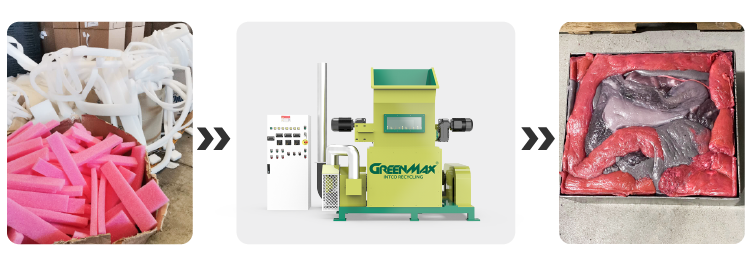
According to GREENMAX Australia, its local product line includes cold compactors, hot melters, foam crushers, and shredders for materials such as EPS, EPE, and EPP. INTCO Recycling, GREENMAX’s parent recycling network, says its broader EPS solution also includes densifiers, foam washing systems, pelletising systems, and buy-back of compressed EPS scraps for reuse in new products.
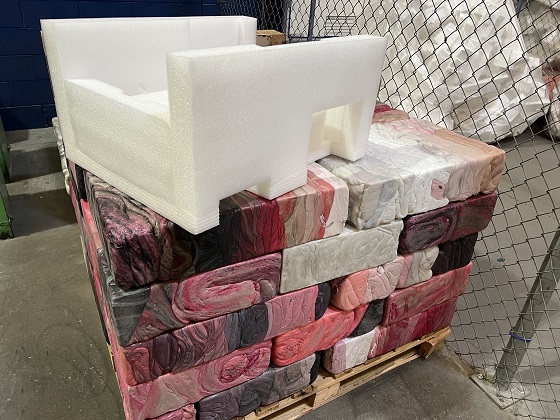
For solar warehouses, distributors, installers, and battery suppliers, that creates a practical recycling route. Clean EPS or EPE corner protectors and foam inserts can be separated at source and densified on-site. GREENMAX says its EPE hot melter can achieve about a 90:1 compression ratio, while its solar battery packaging case states that PE foam and polystyrene packaging can be reduced by up to 90 times through compaction or melting. For bubble wrap and other soft plastic film, GREENMAX also markets a plastic film granulator for Australian soft-plastic recycling applications.
Taken together, this suggests a workflow that fits the solar industry’s actual pain points: reduce bulky foam at the warehouse or project level, lower storage and outbound transport costs, keep soft plastics separate from cardboard and metals, and move processed material into downstream recycling rather than landfill. That logic lines up with the documented Australian challenges around EPS transport economics and kerbside limitations.
Conclusion
Australia’s solar industry is still growing, but the growth story has changed. Today, the sector is being shaped by three forces at once: continued rooftop solar leadership, rapid battery adoption, and policy support for both deployment and domestic manufacturing. At the same time, the industry’s logistics footprint is generating more bubble wrap, EPS, EPE, and other protective packaging waste that standard kerbside systems are not designed to handle.
For Australian solar businesses, the opportunity is clear: treat packaging waste as part of solar operations, not as an afterthought. Companies that separate materials early, simplify packaging design, and use specialist recycling solutions such as densification and film processing can reduce waste-handling friction and move closer to a circular solar supply chain.
FAQ
What are the biggest trends in Australia’s solar industry right now?
The biggest trends are continued rooftop solar leadership, a strong shift toward solar-plus-storage, rising policy support for batteries, and growing pressure to improve grid integration. By the end of June 2025, Australia had 4.2 million rooftop installations, and by the end of 2025 household battery installations had reached 454,753.
What government policies are supporting the Australian solar market?
The main federal supports are the Small-scale Renewable Energy Scheme for rooftop solar and batteries, the Capacity Investment Scheme for renewable generation and dispatchable storage, the Cheaper Home Batteries Program from 1 May 2026, and ARENA’s Solar Sunshot program for domestic PV manufacturing.
Why does the solar industry generate so much foam and bubble packaging?
Because solar panels, batteries, and power electronics are fragile and travel through mechanically demanding logistics chains, they need cushioning and protection during shipping. Common solar packaging includes bubble wrap, foam inserts, corner protectors, films, and corrugated materials.
Why is bubble wrap and foam packaging difficult to recycle in Australia?
Bubble wrap is a soft plastic and is not accepted in most standard kerbside recycling systems. EPS foam also has limited collection options, is not kerbside recyclable in Australia, and is expensive to transport because it is bulky but lightweight. Mixed-material packaging makes recycling even harder.
What recycling solution does GREENMAX provide for solar packaging waste?
According to the company, GREENMAX provides cold compactors, hot melters, foam crushers, shredders, and plastic film granulators for EPS, EPE, EPP, and soft plastic recycling. Through INTCO Recycling, the model also extends to downstream processing and buy-back of compressed EPS material.
How can solar businesses reduce packaging waste immediately?
A practical first step is to separate clean foam, soft plastics, cardboard, and metals at source, avoid unnecessary mixed materials where possible, and densify bulky foam before transport. That reduces storage pressure, cuts freight inefficiency, and makes downstream recycling more workable.