 Select Languange
 English
 Spanish
 Polish
 Japanese
 Italian
 French
Customized EPS Foam Recycling Machine for US Clients
Expanded polystyrene (EPS) packaging keeps your products safe, but once the goods are shipped, the foam stays behind. It’s light, bulky, and notoriously expensive to store and haul. For many US factories and distribution centers, EPS is one of the most frustrating waste streams on site.
Operations and sustainability teams often tell us the same thing:
“We have a lot of EPS to deal with, but our current setup is labor-intensive and inconsistent.”
That’s why GREENMAX designed a customized EPS foam recycling machine for a US customer who needed a more stable, space-saving way to handle their foam. Today, we use that experience to help other American manufacturers and recyclers with free, tailored foam recycling solutions based on their own materials and on-site conditions.
The Real Pain Points of EPS Recycling in US Facilities
If you walk through a typical warehouse or DC in the US, the EPS situation usually looks familiar:
Loose EPS corner blocks and end caps filling gaylords, cages or large plastic bags.
Stacks of foam near the docking area because there’s no time to compact it immediately.
A melter that’s either overfed and jamming or underfed and underperforming.
Inconsistent output density, making compacted logs or blocks hard to stack and inefficient to ship.
Operators frustrated by stop-and-go feeding and constant manual adjustment.
One of our US customers, a mid-sized home appliance distributor, was in this exact position. They had basic EPS recycling machine, but it was never designed for the real-world flow of material in their warehouse. Sometimes three people would be tied up just trying to keep the machine running smoothly.
What they needed wasn’t just a bigger machine. They needed a better-designed system that matched their layout, their labor, and the way EPS actually arrives and moves through their facility.
GREENMAX Customized EPS Foam Recycling Machine
Instead of simply offering an off-the-shelf unit, GREENMAX designed a complete EPS foam melting machine customized to this customer’s needs.
The central idea was:
Separate the messy, irregular part of the job (feeding foam) from the precise, controlled part (densifying foam).
The final solution included:
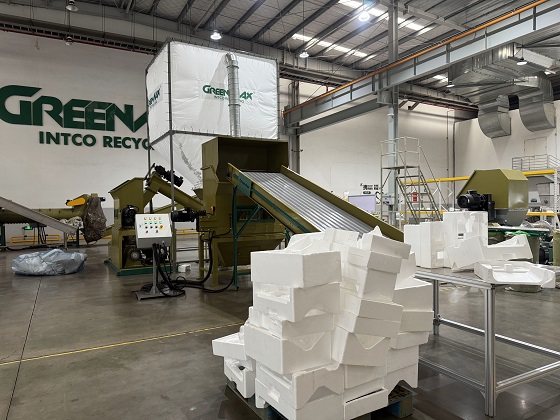
An independent EPS crusher
A buffer silo for temporary storage of crushed EPS
A screw conveyor (auger) to feed the melter at a stable rate
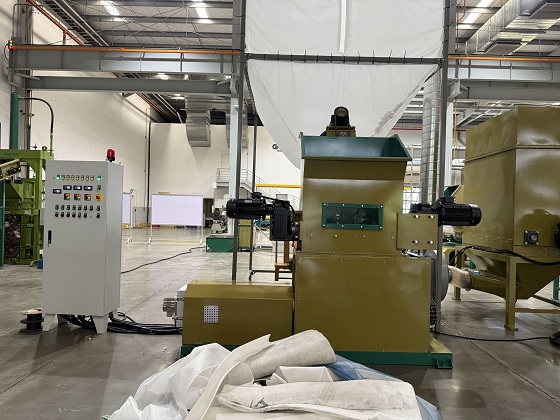
A foam melting machine with:
Automatic feeding from the screw conveyor
A direct manual feeding inlet for flexible operation
Everything was designed around the customer’s material characteristics, target capacity, site layout and operator habits. The result: a customized foam recycling solution that actually fit their daily workflow.
Independent Crusher + Silo + Screw Feeding: How It Works
Step 1: Crushing EPS Foam
Operators bring EPS packaging waste – corner blocks, edge guards, end caps, and sometimes large sheets – to the independent crusher.
The foam goes into the hopper, usually from a bin or directly from a pallet.
Inside the crusher, rotating blades break the EPS into smaller pieces or beads.
This step:
Makes the material much easier to transport within the system.
Prevents large pieces from causing bridging or blockages at later stages.
Gives you a more uniform input for the melter.
At this point, your loose, awkward EPS packaging is already more manageable, but the real efficiency comes from what happens next.
Step 2: Temporary Storage in the Silo
From the crusher, the shredded EPS is blown or conveyed into a silo – a tall storage tank designed for very light material.
Why bother with a silo?
It acts as a buffer between manual work and the automated melter.
Your team can feed the crusher at a pace that fits their other tasks, while the silo keeps accumulating material.
The melter doesn’t need to start and stop every time an operator is busy elsewhere; it can pull material from the silo steadily.
In many US warehouses, we position the silo to use vertical space against a wall or column. That way you gain storage capacity without sacrificing valuable floor area.
Step 3: Stable Feeding with a Screw Conveyor (Auger)
At the base of the silo, a screw conveyor (auger) draws crushed EPS and feeds it into the foam melting machine.
This is where the system becomes truly stable:
The screw turns at a controlled speed, delivering a continuous, even flow.
The melter receives just the right amount of material, minute by minute.
You avoid the peaks and valleys of manual feeding – no flooding the machine, no starving it.
For your operation, this means:
Consistent output density – compacted logs or blocks are uniform in size and weight.
Predictable throughput – you can plan how many pounds per hour the line will handle.
Less operator stress – no more constant start/stop and manual throttling of foam.
Dual Feeding Options: Automatic and Direct
One smart feature of this customized EPS foam recycling machine is the dual feeding design.
Besides the automatic screw feeding from the silo, we kept the melter’s direct feeding inlet:
Operators can feed EPS directly into the melter for small batches, trials, or urgent materials.
If you have a few pieces to process at the end of the shift, you can run them quickly through the direct inlet without starting the whole line.
So you get the best of both worlds:
Automated, stable feeding for daily high-volume work
Manual flexibility when you need it
This kind of design respects the reality of busy US warehouses, where not every load arrives in a perfect, continuous flow.
Benefits for American Foam Recyclers & Manufacturers
A well-designed EPS recycling machine isn’t just about technology; it’s about daily numbers and real savings.
1. Higher throughput with controlled labor
Thanks to the silo and screw conveyor, the melter can run continuously. One or two operators can handle tasks that used to require more people because they’re not fighting inconsistent feeding all day.
2. Uniform, marketable output
When your melter receives a consistent flow of crushed EPS, the resulting blocks or logs are dense, uniform, and easier to stack. That makes storage simpler and can help you achieve better freight efficiency and stronger relationships with downstream recyclers.
3. Significant space and logistics savings
Loose EPS consumes huge volumes of warehouse space. Converting it into compact, dense blocks means:
Fewer pallets used
Less floor space taken
Lower hauling frequency and cost
4. Operator-friendly operation
Because the line is designed around your dock positions, forklift routes, and existing processes, operators don’t need to fight against the layout. The crusher, silo, and melter fit into the way your warehouse already works.
5. Future-proof flexibility
Even if your EPS volume changes or new product lines alter the size and shape of your packaging, the customized foam recycling solution has enough flexibility in layout and control settings to adapt.
Case Story: How a US Appliance Distributor Upgraded Its EPS Recycling
The Initial Situation
The company distributes large home appliances across multiple states. Every inbound truck brings:
EPS corner blocks and end caps from imported units
Long EPS edge protectors from domestic packaging
Occasional oversized EPS pieces from custom shipments
They had a small melter installed in a corner of the warehouse. It worked, but only under ideal conditions:
When operators fed slowly, the melter ran smoothly but total volume was low.
When they tried to push more foam through, the machine would jam or run unevenly, creating logs with different densities.
EPS bags and gaylords piled up around the docks, waiting for their turn at the melter.
At times, three workers were involved just to keep the area under control.
Discussion & System Design
The GREENMAX team treated this as a system design project rather than a single machine sale.
We started by:
1. Reviewing photos and videos of the EPS waste and the current handling area.
2. Estimating daily EPS volume and peak periods based on truck schedules.
3. Checking available space, ceiling height, power supply, and forklift routes.
4. Talking with the warehouse manager about operator habits – who would feed the crusher, who would handle outbound blocks, and how often they could dedicate time to the line.
From there, we proposed a system combining:
An independent EPS crusher located near the main dock door, where waste first appears.
A vertical silo placed along a wall to keep forklift aisles clear.
A screw conveyor running from the silo to the foam melter.
A melter with both automatic feeding from the screw and manual direct feed for special cases.
We prepared a site-specific layout drawing, with realistic clearances and service space, so the customer could see exactly how the system would sit inside their warehouse.
Results After Installation
Once the system was installed and operators trained:
The melter began running more consistently throughout the shift.
One operator could manage crusher feeding and general supervision, while another handled finished EPS blocks and palletizing.
Loose EPS foam stopped piling up near the dock; it went straight from unloading to crushing, then into the silo.
Truckloads of compacted EPS became more predictable in weight and volume, helping the company optimize their recycling logistics.
Their warehouse manager’s feedback was simple:
“It finally feels like the system is working with us, not against us.”
How GREENMAX Designs an EPS Foam Recycling Machine for You
Every site is different, so GREENMAX focuses on tailored designs rather than generic layouts. Here’s how the process usually works:
1. Material & volume assessment
You share details on your EPS types (blocks, sheets, cut-offs), contamination, and volumes per day or per week.
2. Capacity and automation targets
We clarify whether you want to run the line continuously, in batches, or mainly during certain hours, and how many operators you can assign.
3. On-site conditions review
Using floor plans, simple sketches, or photos, we analyze your dock positions, storage zones, columns, ceiling height, and traffic routes.
4. Customized system proposal
We recommend the right combination of crusher, silo, screw conveyor, EPS foam recycling machine, tailored to your site and goals.
5. Free customized foam recycling solution
GREENMAX provides a no-cost proposal with layout options, line diagrams, key specifications, and practical recommendations you can review with your team.
6. Implementation and training support
After you move forward, we support installation and operator training so your staff feel confident running and maintaining the system.
7. Long-term partnership
As your EPS volume or product mix changes, we’re available for adjustments, upgrades, and technical support.
FAQs About EPS Foam Recycling
Can one system handle different shapes and sizes of EPS?
Yes. A properly designed EPS foam recycling machine line with an independent crusher and silo can handle a wide range of packaging shapes and sizes – from small end caps to large corner blocks and edge protectors.
Why use a foam melting machine instead of baling EPS?
EPS is extremely light and springy. An EPS foam melting machine compacts it into dense blocks or logs with far higher density than a baler usually can achieve. That means fewer truckloads, lower hauling costs, and better handling for recycling partners.
Is a silo and screw conveyor always necessary?
If your EPS volume is very small or irregular, you might manage with basic EPS recycling machine and manual feeding. However, for most medium to high-volume sites, the crusher + silo + screw feeding configuration dramatically improves stability, throughput and labor efficiency.
How customized can the system be?
Very. GREENMAX can adjust machine models, silo volume, conveyor length and angle, discharge height, and overall layout according to your building, electrical standards, material flow, and labor setup.
Talk to GREENMAX for a Free Customized EPS Recycling Proposal
If your EPS waste is taking over valuable space or causing headaches for your team, it’s a good time to look at a smarter system.
Share your EPS photos, basic layout, and capacity needs with GREENMAX, and we’ll design a free, customized foam recycling solution for your site – including a complete EPS foam recycling machine, crusher, silo, and melter configuration tailored to your operations.