 Select Languange
 English
 Spanish
 Polish
 Japanese
 Italian
 French
How Australian EPS Manufacturers Are Responding to Plastic Bans – and How GREENMAX Can Help
Australia’s EPS (expanded polystyrene) industry is under real pressure to change. State governments are tightening rules on single-use plastics, retailers are rewriting packaging specs, and manufacturers and cutters are being pushed to prove they can recycle their own material, not just make it.
At the same time, industry bodies and recyclers are investing in new EPS recycling capacity, creating a clear opportunity for on-site EPS melting machines and integrated recycling systems from brands such as GREENMAX to slot into the new supply chain.
New bans are forcing a rethink on EPS packaging
Several Australian jurisdictions have now moved from “talking about” problematic plastics to actually banning them – including key EPS items:
South Australia has extended its single-use plastics rules to include EPS cups and bowl packaging from 1 September 2025, alongside other items like pre-filled soy sauce containers and attached cutlery.
Western Australia will enforce a stage-2 ban on moulded EPS and other foamed plastic packaging from 1 July 2025, hitting items such as shaped transport packaging.
New South Wales has updated plastics bans guidance from 1 January 2025, covering integrated single-use plastic components on packaged food and drinks – a direct signal to brands using EPS and other plastics in retail packaging.
At the national level, the National Plastics Plan and the APCO roadmap set a trajectory to phase out business-to-consumer EPS in many packaging formats, encouraging either alternative materials or robust recycling solutions.
For EPS manufacturers and cutting shops supplying packaging, boxes, sheets, and waffle pods, this doesn’t mean EPS is “over”. It means unrecycled, linear EPS is no longer acceptable. To stay in tenders and supermarket supply chains, producers need credible, traceable recycling systems that match this new regulatory climate.
Industry news: from cutting foam to closing the loop
Australian EPS manufacturers and recyclers are already moving in this direction:
Polyfoam has opened a new production and recycling facility in Westbury, Tasmania, doubling its salmon box capacity and installing a state-of-the-art polystyrene recycling service. The plant turns used EPS – from white goods packaging to produce boxes – into new building products, cutting landfill while supporting the aquaculture sector.
Through Expanded Polystyrene Australia (EPSA) and partners such as StyroCycle, a growing network of EPS drop-off points and recycling centres has been rolled out across major states, making it easier for businesses to divert clean EPS from landfill.
EPS manufacturers and recyclers like Foamex, Polyfoam, National Polystyrene Systems, and IS Recycling are publicly positioning EPS as a 100% recyclable material and promoting recycling services for packaging, logistics, and construction waste.
All of this points in the same direction: EPS will stay in the market where it delivers performance, but only when manufacturers and cutters can show that waste offcuts, blocks and packaging are being captured, densified and re-used.
Pain points for EPS manufacturers and cutters
On the factory floor, most Australian EPS plants face similar problems:
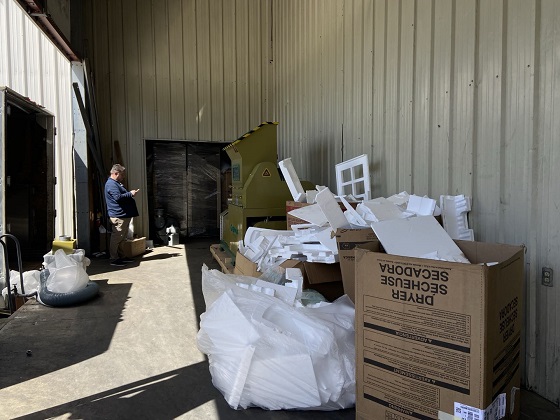
Bulky offcuts and blocks from cutting lines and CNC machines quickly fill cages and bins.
Transporting loose EPS to external recyclers is expensive, often mostly “air” in the truck.
Landfill fees continue to rise, and sending EPS to landfill looks bad in sustainability reports.
Customers – especially in construction, seafood and fresh produce – are now asking for documented recycling rates and evidence of circular solutions.
This is exactly the environment where on-site EPS melting machines and integrated EPS recycling systems become strategic, not just “nice-to-have” equipment.
How GREENMAX EPS melting machines fit into the Australian market
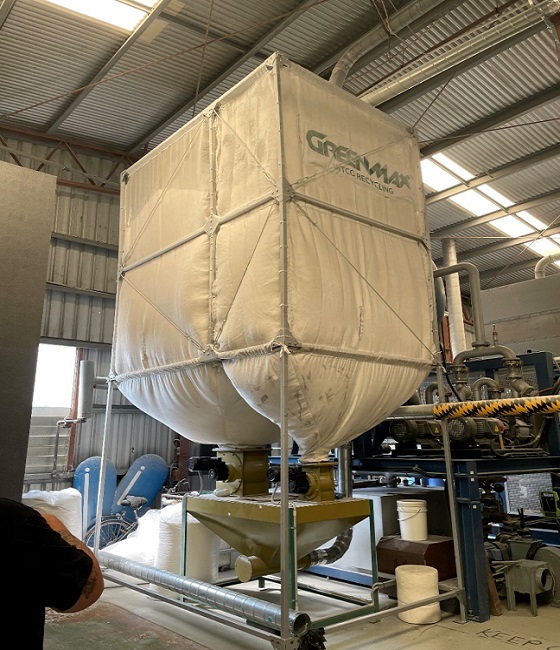
According to industry guidance on EPS recycling in Australia, collected EPS can be efficiently processed using compactors and recycling systems like those supplied under the GREENMAX brand, turning bulky foam into dense, reusable material for new products.
For an EPS manufacturer or cutter, a typical GREENMAX-style solution can:
Dramatically reduce volume of EPS waste by melting and compacting it into solid ingots or blocks. A truck that once carried loose foam can now move many times more material in one load.
Create a saleable secondary raw material that can be granulated and turned into items such as picture frames, skirting boards, or other plastic profiles, depending on downstream partners.
Stabilise quality by processing clean, in-house offcuts before they mix with dirty post-consumer waste.
Support compliance with customer and retailer requirements around landfill diversion and recycled content.
Because many Australian recyclers already accept compacted or melted EPS, plants that install an EPS melting machine can plug directly into existing take-back networks, rather than waiting for municipal solutions to catch up.
Building an EPS recycling system around your plant
For EPS manufacturers and cutting facilities, the most effective approach is to think in terms of a system, not just a machine. A GREENMAX-based solution can be designed around a few practical steps:
Audit your EPS streams
Separate internal offcuts, sheet trimmings, and block waste from post-consumer returns.
Identify the cleanest, highest-volume flows for on-site melting.
Install the right EPS melting capacity
Position the EPS melting machine close to cutting lines or baling areas.
Feed offcuts continuously during shifts to avoid pile-ups and double-handling.
Integrate with logistics and partners
Store dense ingots on pallets rather than loose bags of foam.
Partner with local EPS recyclers or plastic processors who can buy or take the melted material as feedstock.
Capture post-consumer opportunities
For seafood boxes, appliance packaging or construction returns, set up back-loading or drop-off programs where feasible.
Use the same melting system to process these additional streams, as long as contamination is controlled.
Report the numbers
Track tonnes of EPS processed through the melting machine.
Feed this data into ESG reporting, customer tenders and retailer scorecards to demonstrate real landfill diversion.
With this kind of system in place, an EPS plant can switch from a “foam waste problem” to a circular business model that aligns with government roadmaps and industry sustainability messaging.
Why acting now makes business sense
Australia’s bans and phase-out timelines for EPS packaging are no longer distant policy ideas – key dates in 2025 are already locked in at state level, and industry bodies are openly promoting closed-loop EPS recycling.
For EPS manufacturers and cutters, investing in GREENMAX EPS melting machines or full EPS recycling systems now can:
Protect key accounts that are tightening sustainability requirements.
Turn a high-volume waste stream into a measurable resource.
Reduce storage, handling and transport costs for loose EPS.
Position your business as a proactive partner in Australia’s transition to circular packaging.
In short, EPS still has a strong future in Australia – but it will belong to the companies that can show, in hard numbers and metal on the factory floor, that they know how to recycle what they sell. GREENMAX-style EPS melting and recycling systems give manufacturers and cutters a practical, scalable way to do exactly that.