 Select Languange
 English
 Spanish
 Polish
 Japanese
 Italian
 French
EPE Foam Recycling in Australia: Policy Pressure Is Rising (and Landfill Isn't Getting Cheaper)
If your business receives products packed in EPE foam (expanded polyethylene)—think furniture edges, appliance protection, electronics cushioning—you already know the problem: it’s light, bulky, and never seems to stop coming.
In Australia, that issue is getting harder to ignore. Two things are happening at the same time:
Western Australia’s “moulded expanded plastic packaging” ban took effect on 1 July 2025, and it explicitly captures expanded & foamed plastics including EPE.
The federal government has been pushing forward on packaging regulatory reform, after broad stakeholder consultation on reform options.
Meanwhile, the country is also trying to rebuild trust and capacity in plastic recycling (for example, the opening of Australia’s first large-scale soft plastics facility and national soft plastics stewardship developments).
So where does that leave EPE?
For many Australian sites, the most practical first move is simple: stop paying to transport air—densify EPE where it’s generated, and create a material stream that recyclers can actually use.
That’s exactly what GREENMAX EPE recycling machines are built for.
Why the WA expanded plastics ban matters even if you’re not in WA
WA’s plastics ban applies to businesses operating in Western Australia, but supply chains rarely stay inside state borders. If you’re supplying into WA (or receiving goods packed for WA), you may be asked to:
1. Prove packaging compliance
2. Switch to approved alternatives
3. Manage take-back / reuse / recycling pathways for expanded plastics
WA’s ban information makes it clear the restriction covers “expanded and foamed plastics” such as EPS, EPE, EPP, EVA and more.
And importantly: the policy focus isn’t only about litter—it’s also about the reality that expanded plastics don’t work well in kerbside recycling and often break apart, making recovery difficult.
The uncomfortable truth: EPE recycling options are limited unless you change the form
A lot of businesses ask: “Can EPE go in the recycling bin?” In most places, the realistic answer is no.
One example: Monash University’s recycling guidance notes they haven’t found an Australian facility that accepts EPE, and directs it to landfill in that context.
At the same time, specialist operators do exist (and in some areas they accept expanded foams including EPE).
So why does EPE still get landfilled so often?
Because EPE’s density is extremely low. Transporting loose EPE is basically transporting a truckload of… nothing. Costs climb fast, and recyclers can’t justify collection unless the material is prepared properly.
That’s where EPE recycling machines make the difference.
The practical Australian solution: densify EPE at the source
What “densifying” EPE means
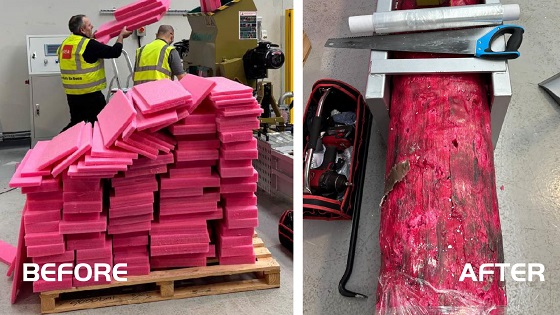
Densifying (or compacting) takes loose foam and turns it into a much smaller, heavier form—typically:
Either way, you end up with:compacted blocks/logs, or
processed melt output (depending on system design)
1. Far fewer collections
2. Lower storage space
3. Better material value
4. A more realistic pathway to recycling
How GREENMAX EPE recycling machines fit into the workflow
GREENMAX systems are designed around one idea: make foam manageable.
A typical on-site workflow looks like this:
1. Collect clean EPE foam (packaging offcuts, edge protectors, sheets)
2. Feed into an EPE compactor/densifier
3. Output densified material that’s suitable for storage, transport, and downstream processing
If your site generates high volumes daily (distribution centres, appliance warehousing, import operations), an on-site system can turn an ongoing waste headache into a controlled process.
Who in Australia usually needs an EPE recycling machine?
You’re a strong candidate if EPE is showing up in your bins every week from:
Appliance & electronics warehousing
Furniture importers / retailers
E-commerce fulfilment centres
Manufacturing plants using EPE for protection or interleaving
Logistics providers (3PLs) handling packaged goods
If you’re in WA, the compliance pressure is more direct since the ban is already in effect (1 July 2025).
If you’re outside WA, the market pressure often comes from customers and packaging requirements, especially as packaging regulation reform progresses nationally.
Why this matters now: packaging reform + rebuilding plastics recycling
Australia is moving toward tighter expectations around packaging outcomes. The federal department’s packaging reform work summarises broad engagement and consultation on options to reform packaging regulation.
At the same time, soft plastics recycling is restarting at scale in parts of the country, and the ACCC has authorised an industry-led scheme to operate for soft plastic packaging.
EPE foam isn’t the same as soft plastic film—but the direction is clear: more scrutiny, more demand for proof, more focus on real recycling capacity.
For EPE, “real recycling” almost always begins with volume reduction.
Getting started: a simple checklist for Australian sites
Before buying any equipment, do these steps:
Measure your EPE volume (bags per day/week, skip bin frequency, warehouse space used)
Separate by cleanliness (clean packaging foam is easiest; contaminated foam is harder)
Decide your outlet: recycler pickup (preferred), or baled/densified shipments to a processor, or internal reuse for protection (where practical)
Plan the footprint (where the machine will sit, power access, safe feeding area)
If you want a starting point specifically written for the local context, GREENMAX also publishes an Australia-focused guide on EPE recycling and equipment options.
FAQ: EPE foam recycling in Australia
Is EPE foam banned in Australia?
Not nationally across all uses. But Western Australia’s ban on moulded expanded plastic packaging is in force from 1 July 2025, and the ban scope includes expanded & foamed plastics such as EPE (with exemptions in specific cases).
Can I put EPE foam in kerbside recycling?
Generally, no. Expanded/foamed plastics typically aren’t suitable for kerbside systems, and guidance from institutions like Monash notes they have not found an Australian facility that accepts EPE in their context.
What’s the biggest barrier to recycling EPE?
Transport economics. Loose EPE is mostly air. Without densifying/compacting, it’s often too costly to collect and move.
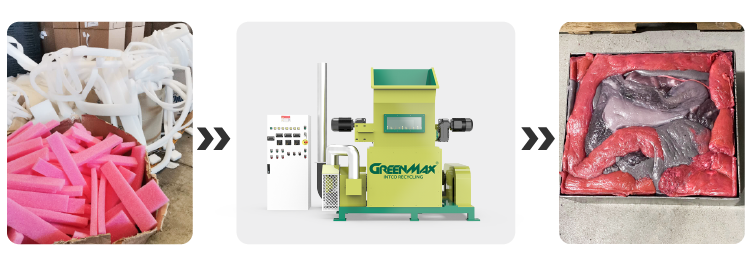
What does an EPE recycling machine actually produce?
Most on-site systems focus on densified material (reduced volume, higher density) that can be stored and transported efficiently for downstream recycling.
Do I need a full recycling line, or just a compactor/densifier?
If your immediate pain is space + disposal cost, start with densifying. If you’re aiming to produce a more processed output stream, you can scale up later.
Is there any momentum in Australia for plastics recycling right now?
Yes—soft plastics processing capacity is restarting and scaling in NSW, and national stewardship approaches have been approved to operate for soft plastic packaging.
(Again: EPE foam is different, but the policy and market direction is toward measurable outcomes.)
Closing: make EPE manageable, then make it recyclable
If EPE is piling up behind your warehouse, you don’t need a “perfect” national collection system to start improving outcomes. You need a way to reduce volume, stabilise the material stream, and create a realistic recycling pathway.
That’s what GREENMAX EPE recycling machines are for: practical, on-site volume reduction that fits the way Australian warehouses and logistics sites actually operate.