 Select Languange
 English
 Spanish
 Polish
 Japanese
 Italian
 French
Polyethylene Foam Recycling Australia | GREENMAX PE Foam Recycling Solution
Polyethylene foam, especially expanded polyethylene (EPE) foam, is widely used in Australia for furniture packaging, appliance protection, electronics cushioning, warehouse packaging and industrial transport protection. Although it is light and effective as a protective material, loose polyethylene foam is bulky, elastic and expensive to transport when it is not reduced in volume. For Australian businesses that generate regular PE or EPE foam waste, the practical recycling route is to sort the material, keep it clean and dry, compact or hot-melt it on site, and then send the dense blocks or ingots into a downstream recycling channel. GREENMAX provides foam recycling machines and recycling support to help businesses turn bulky polyethylene foam waste into transportable, recyclable material.
What is Polyethylene Foam?
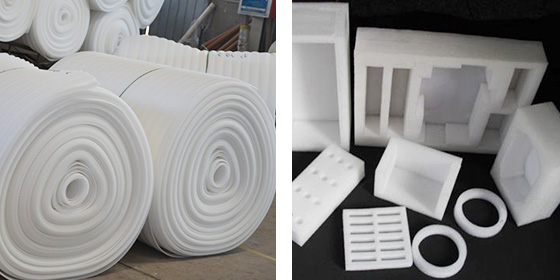
Polyethylene foam is a closed-cell plastic foam made from polyethylene. In packaging, the most common form is EPE foam, also known as expanded polyethylene foam. It is flexible, lightweight, shock-absorbing and moisture-resistant, making it a popular choice for protecting products during storage and transport.
In Australia, polyethylene foam is commonly seen in appliance packaging, furniture imports, electronics distribution, automotive parts protection, glass and equipment packaging, foam rolls, edge protectors and production offcuts from packaging converters. The same properties that make PE foam useful for protection also make it difficult to manage after use: it takes up warehouse space, fills bins quickly and has low transport efficiency when shipped loose.
Why Polyethylene Foam Recycling Matters in Australia
Australia is moving away from a take-make-waste packaging model and toward packaging that can be recovered, reused, recycled and safely reprocessed. For businesses, this means foam packaging waste can no longer be treated only as a disposal issue. It is becoming part of a broader packaging responsibility and circular economy discussion.
Polyethylene foam is not banned nationally across all applications, but the direction of packaging policy is clear: businesses are expected to reduce unnecessary waste, improve material recovery and create more practical recycling pathways. For companies that handle large quantities of PE or EPE foam packaging, on-site volume reduction is often the key step that makes recycling economically workable.
Common PE / EPE Foam Waste from Australian Businesses
|
PE / EPE foam waste type |
Common source in Australia |
Recommended recycling method |
|
EPE foam sheets and pads |
Furniture, appliance, electronics and industrial packaging |
Sort by material, keep clean and compact or hot-melt |
|
PE foam rolls |
Packaging manufacturers, warehouses and product protection suppliers |
Cut, crush or feed into a suitable densifying system |
|
EPE edge protectors |
Furniture, glass, equipment and export packaging |
Collect separately and compact into dense blocks |
|
Moulded PE foam packaging |
High-value equipment, electronics and transport packaging |
Separate from EPS, EPP and mixed plastics before recycling |
|
EPE production offcuts |
Foam converters and packaging factories |
Directly collect and densify for stable recycling output |
|
Mixed or contaminated PE foam |
Distribution centres and importers |
Remove tape, labels and other contaminants before processing |
Why Loose Polyethylene Foam Is Difficult to Recycle
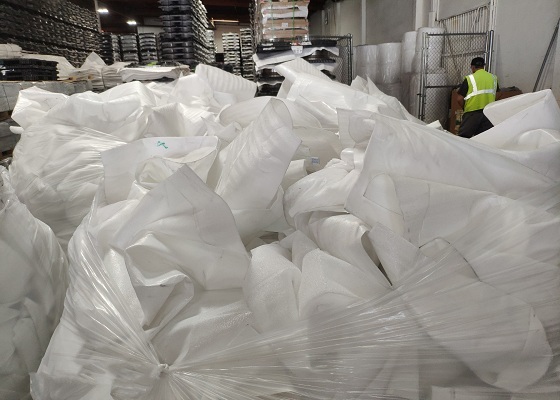
Loose PE foam has a high volume-to-weight ratio. A large amount of warehouse space can be occupied by material that weighs very little. This increases skip usage, storage pressure and freight cost. EPE foam is also elastic, so it can rebound after simple compression if the material is not processed with the right compaction or surface-fusion method.
Contamination is another challenge. PE foam should be kept separate from EPS, EPP, cardboard, tape, labels, food residue and general waste. Clean and dry material is easier to compact, easier to sell and more suitable for downstream recycling.
How to Recycle Polyethylene Foam in Australia
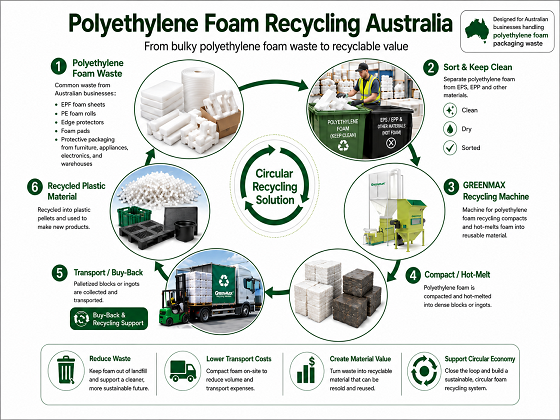
The recommended recycling process for Australian businesses is simple and operationally practical:
1. Collect polyethylene foam waste separately from general packaging waste.
2. Sort EPE / PE foam from EPS, EPP, paper, film and mixed plastics.
3. Keep the material clean and dry to improve recycling quality.
4. Feed the foam into a GREENMAX polyethylene foam recycling machine.
5. Compact or hot-melt the foam into dense blocks or ingots.
6. Store and transport the densified output efficiently.
7. Send the material into downstream recycling or use GREENMAX buy-back support where available.
GREENMAX Polyethylene Foam Recycling Machine Solution
GREENMAX provides industrial foam recycling equipment for businesses that need to reduce bulky PE / EPE foam waste on site. The suitable machine depends on the material form, daily volume, space, output requirement and downstream recycling plan.
|
Recycling goal |
Recommended GREENMAX solution |
Expected output |
|
Reduce bulky EPE packaging waste |
ZEUS EPE foam compactor |
Dense compacted EPE blocks |
|
Prevent foam rebound after compression |
ZEUS compactor with surface fusion |
Stable blocks for storage and transport |
|
Maximise volume reduction |
MARS hot melting machine |
Dense hot-melted ingots |
|
Prepare material for higher-value reuse |
Pelletising solution where suitable |
Recycled polyethylene pellets |
|
Build a complete recycling route |
GREENMAX machine plus recycling support |
Densified material ready for downstream recycling |
Compacting vs Hot Melting: Which Option Is Better?
For polyethylene foam recycling, the right solution depends on whether the business wants stable compacted blocks or maximum volume reduction through hot melting. Both methods can make loose foam easier to store, move and recycle.
|
Method |
Best for |
Main advantage |
Typical output |
|
Compacting |
Regular EPE packaging waste, sheets, edge protectors and foam pads |
Reduces volume while keeping a clean block form |
Compacted polyethylene foam blocks |
|
Surface-fusion compaction |
Elastic EPE foam that may rebound after simple compression |
Helps keep blocks stable for transport |
Stable compacted blocks |
|
Hot melting |
Businesses seeking higher density and maximum freight reduction |
Produces dense ingots with strong transport efficiency |
Hot-melted foam ingots |
Value of Compacted Polyethylene Foam Blocks and Ingots
Once polyethylene foam is compacted or hot-melted, it becomes far easier to store, palletise and transport. Instead of shipping air-filled loose foam, businesses can move dense blocks or ingots that are more attractive to recyclers and downstream processors.
Densified PE foam material can be used as a recyclable raw material source. Depending on material cleanliness and market requirements, it may be further processed into recycled plastic pellets or other recycled plastic products. This creates a path from packaging waste to material value instead of sending bulky foam to landfill.
GREENMAX Buy-Back and Recycling Support
GREENMAX is not only a machine supplier. For suitable material, GREENMAX / INTCO can also support downstream recycling routes and may purchase compacted or hot-melted foam where the output meets recycling specifications. This helps businesses build a closed-loop or semi-closed-loop recycling model rather than stopping at on-site volume reduction.
For Australian customers, GREENMAX can help assess the material type, daily waste volume, available space, output form and recycling target before recommending a machine model. In NSW and nearby areas, local service coordination can also support installation, training and after-sales communication through the local service network.
Who Needs Polyethylene Foam Recycling in Australia?
This solution is suitable for businesses that generate regular volumes of clean PE or EPE foam packaging waste, including furniture distributors, appliance retailers, electronics warehouses, logistics centres, packaging manufacturers, automotive parts suppliers, equipment importers and recycling companies.
If PE foam waste is filling your warehouse, increasing skip costs or making transport inefficient, the first step is to reduce its volume at the source. GREENMAX can help turn a difficult packaging waste stream into a compact, recyclable material.
Looking for a practical polyethylene foam recycling solution in Australia? Contact GREENMAX to discuss your PE / EPE foam waste, machine options and recycling support. Whether you need a foam compactor, hot melting machine or downstream buy-back route, GREENMAX can help you reduce storage pressure, lower transport costs and create more value from foam packaging waste.
FAQ
Can polyethylene foam be recycled in Australia?
Yes. Clean polyethylene foam, especially EPE foam, can be recycled through specialised recycling routes. For businesses, the material usually needs to be sorted, kept clean and dry, and then compacted or hot-melted before transport.
Is EPE foam the same as polyethylene foam?
EPE means expanded polyethylene. It is a common type of polyethylene foam used for protective packaging, cushioning, furniture packaging, electronics packaging and industrial transport protection.
Why is EPE foam difficult to recycle?
EPE foam is lightweight, bulky and elastic. If it is not compacted or densified properly, it takes up large storage space and is expensive to transport.
What machine is suitable for polyethylene foam recycling?
GREENMAX can provide compacting and hot-melting solutions for polyethylene foam. The suitable machine depends on the foam type, daily volume, available space, preferred output and recycling plan.
Can GREENMAX buy compressed polyethylene foam?
GREENMAX / INTCO can support downstream recycling and may buy back compacted or hot-melted polyethylene foam where the material is clean, dry and meets recycling requirements.
How should businesses prepare PE foam before recycling?
Businesses should keep PE foam separate from EPS, EPP, tape, labels, cardboard, food residue and general waste. Clean and dry foam is easier to compact and more suitable for recycling.